
“When the audience for scientific discourse changes from an audience of scientists to an audience composed primarily of nonscientists, however, the argument’s rhetorical character shifts from forensic to epideictic, a genre of discourse that celebrates (or condemns) its subject matter. Forensic rhetoric is primarily discourse about fact. Epideictic rhetoric, in contrast, is discourse about value.”
[1] Jenell Johnson (2015)
In late 2021 to early 2022, I noticed a dormant passion for science and art, left untouched since I entered University. Various situations and factors led to a spark that commenced my developing identity from a static conformity to a dynamic superposition. In less pretentious-ambiguous terms, I wanted to learn- more than I ever desired before. And one of the first major research projects I initialized was on the beloved idol of the sea… CORAL!
The project I embarked on was to create a magazine that covered all my topics of interests- later becoming the foundations to the animated video series (which I’m still working on). However, I decided to scrap the magazine aspect and instead focus my efforts towards the video projects (and do some blogging on the side). It was a good call as my drawing abilities were/are very poor, so I’d at least want to focus that aspect into something that can accompany the visuals. At the moment, I’m still beating around video ideas (scrapped one that I spent months on) and am currently in the process of re-scripting my first intended OFFICIAL upload.
But, we’ll see- enough on that! What exactly happened with this specific video idea? “Nyatako Info: Reasons Why You Should Care About Coral Reefs”- isn’t this quite interesting? Especially for an audience that might not be familiar with marine biology and oceanography, one of the amusing conversation points I often stray towards is coral’s identification. Did you know that coral is an animal? Not a plant! And while that might be a bit of a common (and somewhat frustrating) thing to repetitively say- similar to stating that “The total number of ways you can scramble a Rubik’s cube actually goes up to 43 quintillion!” It’s very repetitive, but the fact that it’s not well-known outside the interested communities suggests the reality of popular perceptions. You wouldn’t conventionally think an animal that looks like a part of your neighbour’s garden to be in the Kingdom of Animalia. It’s not similarly mobile in such a way as a human, right? Or, what exactly makes an animal, or the distinctive species in the Kingdom of Plantae? And I doubt many people would consider the 43 quintillion possible arrangements of the Rubik’s cube, let alone the methods that allow for each scramble to be solved in less than a hundred moves. Or that you don’t solve the faces- but the layers, or blocks, or whatever the method calls for.
And this is one of the struggles I’m currently facing when it comes to sharing and communicating these relatively obscure topics. In the circles of people who are familiar with the context of the forensic rhetoric associated with the topic, you can converse as if it were about universal topics such as “dis fuckin weather, amirite?” But when it comes to discourse with a wider group, the conversation surrounds the epideictic rhetoric of “meaning”. We all care about the weather (at least I’d assume so), but how about coral?
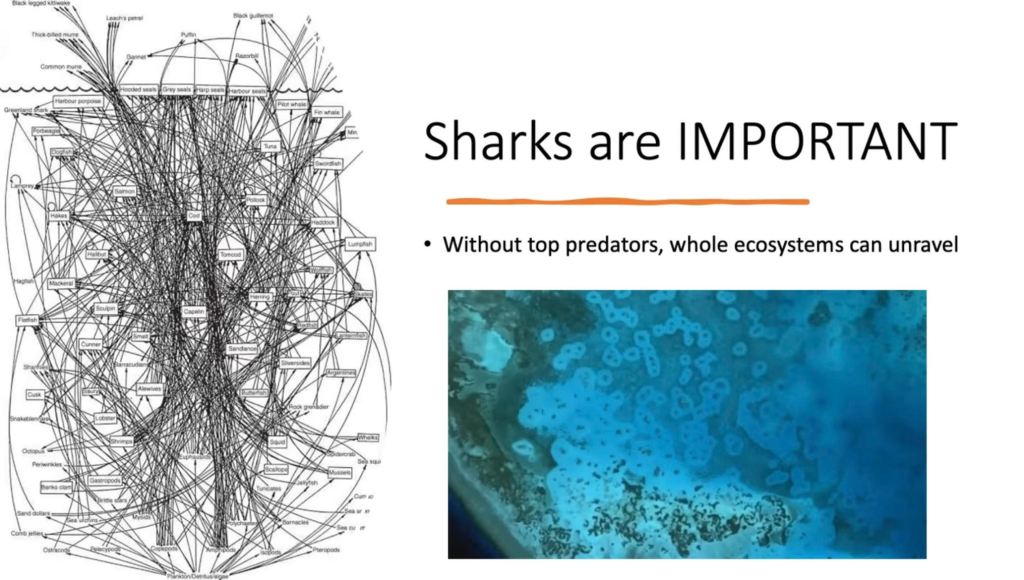
I had a conversation with my dad regarding climate change and its biological effects. He’s familiar with popular ideas concerning the “hole in the o-zone layer” and such, but he isn’t necessarily in-tuned with the specific consequences of the ecosystem. You may be familiar with the type of diagram below if you’ve ever taken a biology course (or something of the like). It refers to the food chain that is present throughout the marine environment. This complex (and not as rigid in reality) string of associations causes major questions regarding the consequences of disruption. The image below is specific to sharks- as I retrieved it from David Shiffman’s talk at the Royal Institution [2]. But how about coral?
There are many videos and articles outlining the consequences of the decline of corals in the ecosystem- they are a foundation species after all. Connected to various species at the bottom, they are at the highest level of the energy budget (trophic levels) for the rest of the organisms present. Meaning that their primary production is where everything starts. Here is a food chain I created based around the coral reef ecosystem:
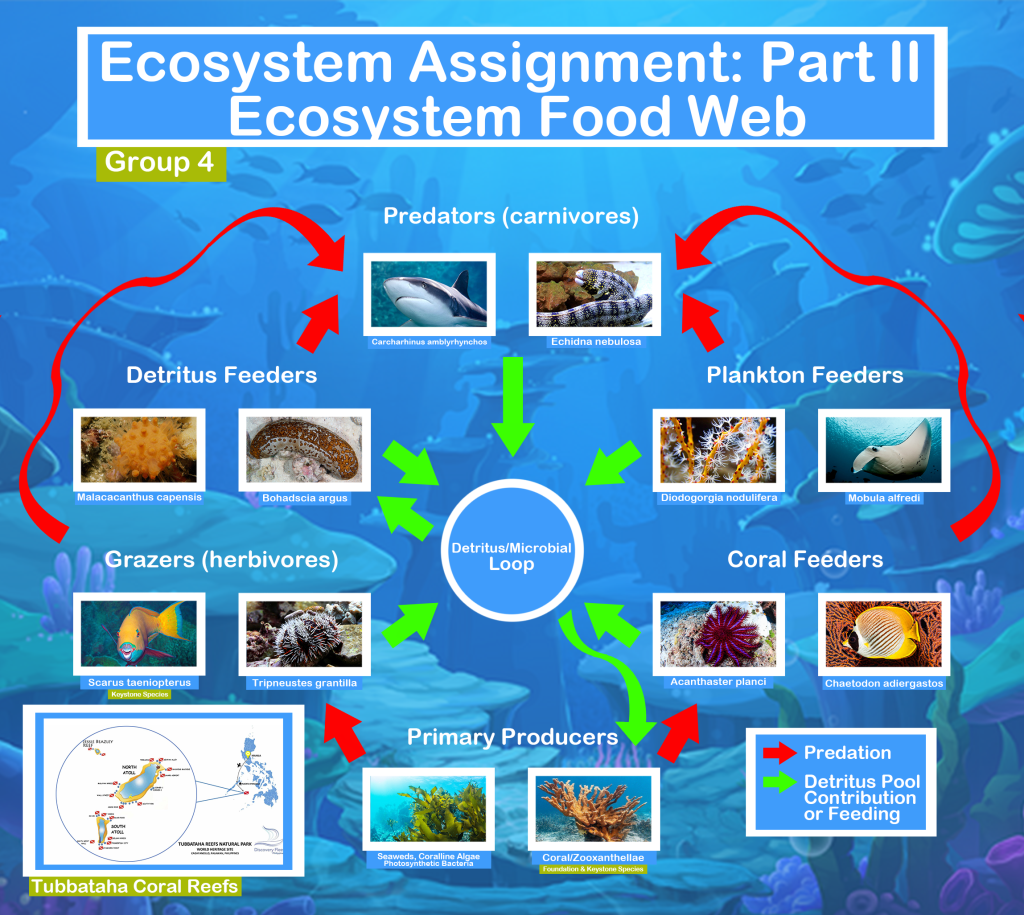
It’s surprisingly difficult to grasp the complex systems derived from our perceived realities. We often aren’t familiar (in our daily lives) with such drastic foundations that make up the whole of the ecosystem. And I’m not sure how effective these diagrams necessarily are at communicating it. But you can imagine this like the popular “Butterfly Effect”, where a flap of a butterfly’s wing in one part of the world can cause a tsunami on the other side. Something seemingly as insignificant as a walk in the part can completely shift your daily schedule. And this was exactly the sort of discussion I was having with my dad while we were driving to Best Buy to get some AAAA batteries for my digital pen (so I can draw for videos!). The fact that specific coral species have such a major role in marine ecosystems that they are basically their own environment… what are the consequences of their decline?
And I’m well-aware with how lacking my explanations for the importance of coral are, but this blog post isn’t necessarily about the complex map of their significance. While I will provide some quick examples, I’m discussing about my struggles to find the *best* format to distribute information- especially in an epideictic rhetorical situation. Nothing I share will necessarily be of interest for scholars of the field. I’m not necessarily qualified myself to be apart of the discourse on coral conservation. So, is it necessary for me- a mindless wanderer of unspecified fields, to be talking about something as significant as coral conservation. What is the role of a normal dude in the vast world of information distribution?
Coral & Algae: Romantic Relationship… really
Don’t laugh… no. Okay fine, you can laugh! The first attempted script I wrote to communicate the symbiotic relationship of coral and algae was based off the concept of “romance”. Here is a little snippet from the opening paragraph: “While there are many fascinating topics to discuss about, our main focus will be on the… romance that breathes life into our world’s coral. Perhaps it’s strange to envision marine life engaging in our conventional ideas of love, but throughout this short series we’ll uncover why many (literally 2) deem this symbiotic-mutualistic relationship as something of a Shakespearian romance. But to be frank, I think this perspective makes for some eye-catching titles.”
As I reflected upon by the end of that atrocious paragraph- yes, it made for some eye-catching titles. Interestingly, this wasn’t my idea. When I first encountered the symbiosis associated with coral, the article that caught my attention was a Benthic Ecology Blog Post by Ariel Pezner. It was titled “A BAD ROMANCE-CLIMATE CHANGE CREATES TOXIC RELATIONSHIP IN CORAL” [5]. I thought it was *genius*, a clever tactic to relate human conceptions of romance into the biological processes that make up coral’s existence. To summarize the gist of the science of the matter, I’ll hand the pen to myself from a year ago (you can skip it if you want, but I found my analogies amusing):
“Endosymbiont zooxanthellae typically make themselves at home within the tissues of coral polyps. Comfortably residing in another organism provides them with lots of protection, while being free-living (out in the water column) has risks of being sucked up by large scary monsters- like society. Fortunately for the landlord coral, zooxanthellae aren’t parasitic and will keep their end of the bargain. As autotrophs, algae are able to perform photosynthesis to produce food for themselves- additionally producing byproducts such as sugars, lipids, and oxygen. This is only possible at photic zones, where light is readily available (where coral reefs typically reside). Since the zooxanthellae live inside polyps, these byproducts are released inside the polyps, which are then used by the polyps for food and to carry out cellular respiration [3]. They ain’t living rent free. Whatever garbage the zooxanthellae produce from photosynthesis, it’s recycled by the polyps for breathing! The cycle isn’t over, however, as the polyps also produce byproducts from respiration. Carbon dioxide and inorganic nutrients such as nitrates and phosphates, which are metabolic waste products of the polyp’s respiration, or byproducts, can then be recycled AGAIN [4]. These are swallowed up and used by the zooxanthellae to undergo photosynthesis. It’s a continuous cycle that puts our motto of “reduce, reuse, recycle” to shame.”
In an attempt to make these concepts a little more relatable, I used the analogy of romance and rent. It was amusing at best, however I decided to scrap this idea as it felt somewhat juvenile. I’m personally quite serious about these topics, and while it may be difficult to communicate that urgency- I found that this sort of “comedy” felt off. If you’ve read my first blog post on my attempts at communicating the urgency of marine debris, perhaps you’d recognize a strange trend between these two projects. In my opinion, it didn’t necessarily teach anything. One of my friends viewed the unfinished “Carnivorous Sponge x Marine Debris” video and received a bit of cheesy entertainment- and that’s all. My core intention is to raise awareness and recognition of certain topics, but a factor to account for is the audience and their perceptions. What do *they* want? And if I go about this in a forensic rhetorical context, it’ll alienate most of the audience that I believe *should* be viewing my content. Of course, there is the balance that communicators strive for. Whatever that balance may be, I didn’t think this hyper-focused view on coral and algae was the best approach.
The many branches of an existence… and why it’s hard to explain
“A narrow Fellow in the Grass
Occasionally rides –
You may have met him? Did you not
His notice instant is -“
[6] Emily Dickinson (1865)
There are many things in the universe that slither around, grasping our attention for a split second before it fades into obscurity by our unconscious will. Perhaps at first, this “slither” wasn’t necessarily associated with something undesirable? But as soon as we encounter a glance at it’s irregular form, we run back to “our nature”. That part of nature… well, it can stay in the thick grass- where uncertainty holds a firm grip on the travelers that dare to venture. And it’s perhaps the most evidence that our immediate nature as humans aren’t associated with the deep sea- where hell is down. Interestingly: “The notion that “the deep” contains “monsters” is so culturally pervasive that psychologists, comparative mythologists, psychiatrists, and neuroscientists have researched why that is” [7].
It’s interesting and quite justifiable why these places are so locked from most people’s view. They associate it with the deepest horrors- some even consider eradicating anything that crawls out. You’d often see people saying “burn the house” when they see a spider crawling around. And it makes sense because we aren’t familiar with them. For deep sea life specifically, they are adapted to the dark environment- typically oxygen-depleted, requiring slow metabolism, eyes designed for picking up faint light, and etc. They need to survive down there, and will look and behave however “weirdly” they can to survive.
This is something to consider when communicating the need for conservation. Referring back to epideictic rhetoric- you have to communicate “why people should care”. Because they won’t particularly try to find out for themselves if they don’t immediately recognize how these ideas are connected to their nature. For all they care, these parts of the world can disappear and their lives wouldn’t be affected. The slithering is just a narrow fellow in the grass– or perhaps just… a narrow thing in the grass? Well, I’m just adhering to the point of the poem, because “fellow” would be a term to describe something with a curious lens- while most people wouldn’t. It’s just a “thing” that exists, but it exists over there. But perhaps it’s interesting to consider the nature of something existing without it influencing its environment- and thus your environment. Its being and influence is not fully confined to its form- which is why I decided to explore (or attempted) the many strings that corals are attached to in the ecosystem of the world.
So here I’ll share another version of my script for this attempted project. This was like… the fourth revision? Anyways, I targeted a different angle from the first draft:
“My best friend HATES cockroaches. I tried to convince him of the ecological benefits of having cockroaches around, but no- perhaps like the majority of you watching this video, he wants them all DEAD. His first decree if he becomes the ruler of the world is to ERADICATE every single particle that identifies with cockroaches. Nitrogen fixation, nutrient recycling and the food chain [8]… whatever the benefits are, SCREW EM. And alright, fine- I know you guys hate cockroaches. But this little debate I had with him made me wonder about the lengths it’ll take to convince people of something’s importance. Maybe not cockroaches, but something bigger. A foundation and keystone species, one that would brutally scar our oceans if they went extinct- one that is currently threatened by climate change; CORAL.
Perhaps the most alien animals in the known ocean [9], coral have been around for hundreds of millions of years and have built up incredible structures for humans to admire. I won’t be talking about the biology of corals in this video- but I’ll have a little summary and video suggestions in the description. In this video, I want to discuss some of the ways that coral can be beneficial to us and nature as a whole. Because maybe you don’t give a damn about cockroaches no matter how important they may be- but let’s give some interest to one of species that will be heavily affected by climate change.”
Ah, yes… BEAUTIFUL! Did this passage catch your eye, your attention? Probably not, but I wrote in this sort of tone to give “character”, although I don’t necessarily feel like it represents me. Well, I’m not sure, but I’m certainly not using this. But I did include a sort of outline for unraveling the benefits of coral:
- Wave energy
- Biodiversity and food
- Medicine
- Additionally pH level, maybe
From here, it’s sort of a mess. It’s a jumble of notes from my research of the scientific literature. If you want to skip through these, go ahead… But I’ll try to summarize my adventure; what I found, how I felt, and how I’m waaaay too ambitious.
Wave Reduction/Attenuation & Coral Mining
The first paper I read was “The effectiveness of coral reefs for coastal hazard risk reduction and adaptation” [10], an analysis (overview) on papers covering the topics of coastal defense (economically, ecologically, effectiveness, etc) comparing reef and artificial systems. This was a quite an informative read and it helped me create a foundation for my understanding of coral as a coastal defense. However, the first line of the introduction really lead me on an unnecessary goose hunt. This is a recurring theme for me whenever I do research…
“Nearly 40% of the world’s population lives within 100 km of the coast and that percentage is increasing.” This statistic is very interesting and is the perfect opener to suggest the importance of addressing coastal risks. However, numbers come up all the time to argue for certain ideas- and it’s especially interesting how they are gathered. This specific statistic came from the 2005 “Ecosystems and Human Well-Being: Current State & Trends” according to the citations. I can’t access it though! Well, no I can- if I go to my University’s library. I don’t… want to though. So, I decided to look for other sources with similar statistics. I found “A Global Estimate of the Number of Coral Reef Fishers” which states that “275 million people who live within 30 km of reefs around the world.” This also has sources for its statistic, but I wrote in my notes:
“First impressions of the data seem to be quite off. If 40% of the world’s population, 6.5 billion in 2005 (when the paper referenced was published) and 40% of that is 2.6 billion- and only 275 million people live within 30km… that’s 10x more. But sure, that could probably be true, I’m just using my ignorant estimations to conclude on this strange statistic. I’ll research about this further.” But the statistic in question is referring to estimations of 100km, not 30km- so it could make sense. And I said I’ll research it further in my notes, but I’m already too far off track at this point. It’s literally the first line of the first paper that I’m reading for this project about coral!
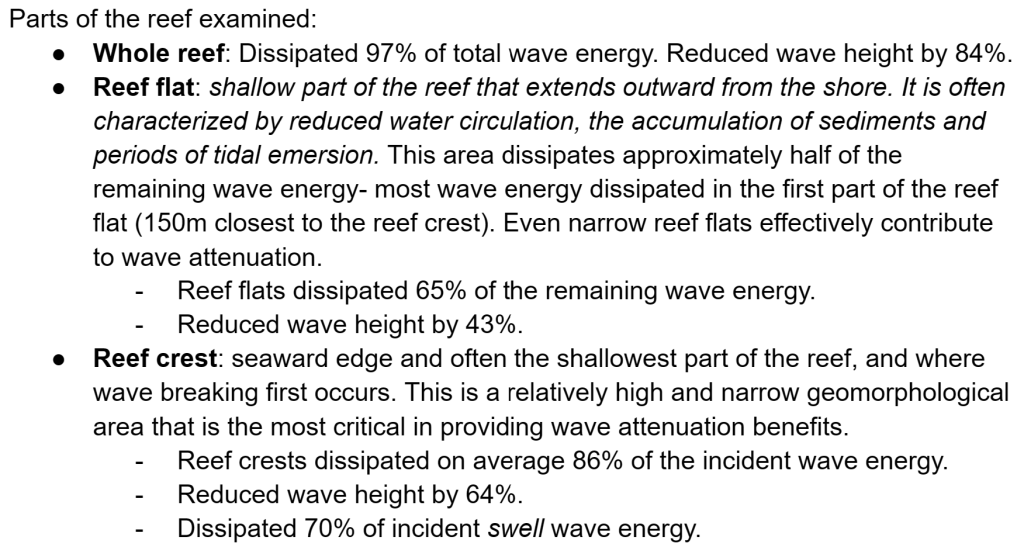
Then the paper goes on about how investments are often for artificial defense structures such as seawall and breakwaters. And low-crested detached breakwaters typically produce 30-70% wave height reduction. But the cost of building tropical breakwaters vs restoration projects of reefs were significantly cheaper than costs of building tropical breakwaters. Additionally, fringing reefs provide a lot of wave attenuation:
Then I wrote a ton about reef geometry and I found it citating something I felt might be wrong… but it was Spanish and I couldn’t find it:
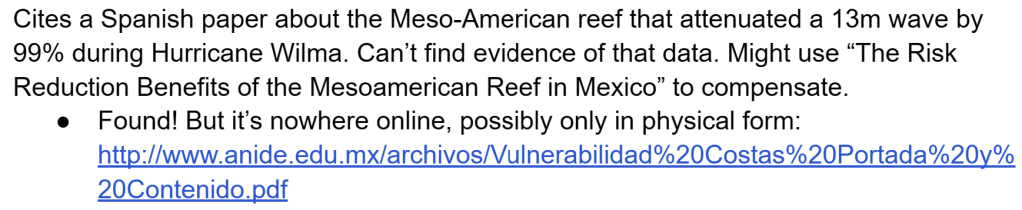
That doesn’t matter though… I already went off track LOL. But I found more statistics! However, this is especially regarding the populations at risk: “Estimated that 197 million people live both below 10m elevation and within 50km of a reef who may receive risk reduction benefits from reefs. Considering areas within 10km of a reef and below 10m elevation, still some 100 million people may receive risk reduction benefits from reefs.” and “Countries with the greatest number of at-risk people who may receive risk reduction benefits from reefs: Indonesia, India, and the Philippines whether considering 10-50 km from reefs. These countries account for ~50% of the people globally living in low exposed areas near reefs. USA ranks in the top 10.”
The general summary of this paper’s quantifiable benefits for preserving coral reefs are:
- For direct exposure reduction benefits… wave energy and flooding reduction, often within just a few kilometres of reefs and the coast (10km).
- Indirect: Extends well beyond those living in frequently flooded areas- populations bearing these coastal defence and replacement costs can include whole provinces or island nations. Benefits include the effects from reduced population vulnerability because of the provision of livelihood opportunities (coastal jobs at ports, hotels or markets) and food security.
Then I found “Ecological consequences of major hydrodynamic disturbances on coral reefs” [11] cited in the previous paper. Now, this one is quite interesting. The researchers created a framework to predict whole-colony dislodgement of corals caused by hydrodynamic force. It measured for 1158 colonies from 3 species of coral on an exposed coral reef at Lizard Island in the Northern region of the Great Barrier Reef. But, anyways… there’s more. And I won’t go into depth about them, but check them out if you’re interested: [12] [13] [14] [15] [16] [17] [18].
These studies explored the role of coral in risk reduction for coastal zones, hard coral stability and vulnerability with increasing storms (El nino events), and the negative affects of coral mining. For most of the studies, I went on another hunt for accurate citations of statistics, such as [14]‘s:
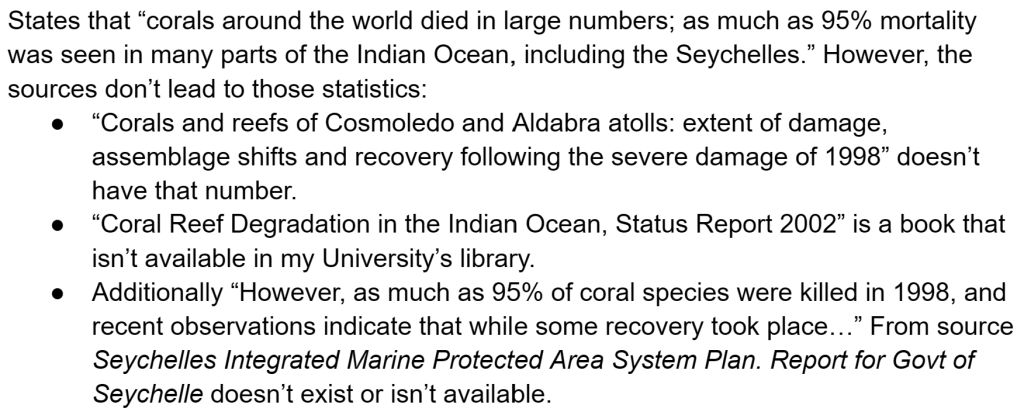
It’s probably not necessary honestly. However, I’d really like to know where most information I’ll potentially share comes from. Especially for science communication, I feel like it’s necessary. I may not be a statistical analyst, oceanographer, or anything of those sorts- but I still want to know!
Fishery Services
Perhaps I’ll just quickly summarize my findings rather than going through all my notes this time? If you’d like to learn more, please leave a comment and I’ll share some more information! Anyways, this section explored our direct source of nutrition from the ecosystem of coral reefs. In the script, I probably would have explained the various factors that contribute to the biological diversity and abundance of certain species. Some of the “cool” activities I’d share that occur in reef systems are symbiotic relationships. [19] provided an overview of the benefits that a structurally complex system created by hard coral allows for diversity. This comes in the form of providing shelter, cleaning stations, etc. And two relationships I’d highlight were the collaboration of interspecies, such as the octopus and reef fishes [20] (the octopus punched the fish out of spite!), and the hunting pair of a grouper and moray eel [21].
This abundance and diversity directly benefits our food supply and careers. 6.1 million world wide; represent about 2% of the 275 million people who live within 30 km of reefs around the world- these people are fishers who benefit from coral reefs [22]. Not to mention the people who benefit from the fishers, which isn’t calculated. Another paper also calculated a general estimate of employed marine fishers: 260 ± 6 million people in total; 22 ± 0.45 million in small scale fishers, 203 ± 34 million full time equivalent fishers, 50 million in primary production sectors [23]. In this section, I probably would have explored the general ecosystem of coral reefs- how it connects with other ecosystems such as mangroves, kelp forests, the deep sea, etc. This is probably where I realized the scale of the project… There is just so much to cover and I don’t want to do it so adequately. But I kept going…
Economics & Numbers
I got invested in the numbers! Oh the damn numbers… But what is the economic scale of coral reefs? I found a paper calculating it tourism benefits: Calculations considered reef-adjacent activities such as food, views, and sandy beaches along with on-reef activities such as diving and snorkelling. The range of coastal tourism was within 30 km (excluding urban areas), resulting in a total of US$36 billion globally, 70 million visitors, or over 9% of all coastal tourism value in the world’s coral reef countries [24]. That’s a lot of money, right? From here, I believe I would have looked at the general national budget and earnings of certain countries, then compared it to this statistic. However, I never got that far.
Coastal protection was also something I viewed in terms of economic benefits. But there were lots of conflicting data. Check out the notes in the citations for [24] and [25].
Then I would have explored species richness! This section is sort of difficult to explain in the context of epideictic discourse. Why should anyone care about preserving the species we aren’t aware of? An estimated 8.74 million eukaryotic species were predicted along with 10100 prokaryotes; 2.21 million marine species, 298 thousand from the plantae domain, etc. “86% of existing species on Earth and 91% of species in the ocean still await description” [26]. What does this entail? Well, we aren’t aware of how much or how little these 86% impact the world. In the video, I would have compared this to dark matter. Because we can sort of see it’s presence, it’s affects- but we don’t know what it is. If it’s gone, how would the universe change? I’d emphasize the overvalue of what is “known” and how we often neglect what is not known. But, more on this in the bioprospecting section.
From here, I also looked at species richness in coral reefs. An estimated 830000 multicellular species (excluding fungi) in the world’s coral reefs. “Less than 9% of all multi-cellular species on coral reefs have been named, an additional ~13% have been discovered but not named, and ~74% of species remain to be discovered” [27]. ~10% of the world’s species are in the world’s coral reefs? After showcasing these statistics, I’d elaborate on the importance of preserving reefs.
Bioprospecting
I gave up on this project before I got to research further on this interesting topic. I began researching with this paper [28], which I used as an outline for my research. There is a section for cnidarians, which I used for information regarding coral species. [29] was very fascinating, from the title itself: “Natural coral exoskeleton as a bone graft substitute: A review”. But, I have zero notes on these two papers… Too bad because they sound so interesting!
Down the rabbit hole of citations
So, I found this little narrative I wrote out of spite. It showcases my adventure searching for accurate information. Enjoy…
“Data” I found while looking for sources for the “0.1% of the ocean” statement that every website seems to recite like a meme. I then came upon the “$375 billion per year” https://ourworldindata.org/coral-reefs#:~:text=You%20will%20only%20find%20corals,0.5%25%20of%20the%20ocean%20floor.
- “They generate an estimated $375 billion per year through the goods and services they provide.” Cited Reefs At Risk Revisited. Couldn’t find numbers anywhere.
- Also stated: “You will only find corals in small areas of the world’s oceans – they cover only 0.5% of the ocean floor.” Provided no sources.
I didn’t trust this source, so I looked for other websites that stated similar numbers. Found this stating $172 billion instead: https://ocean.si.edu/ocean-life/invertebrates/corals-and-coral-reefs#:~:text=They%20teem%20with%20life%2C%20with,percent%20of%20the%20ocean%20bottom. It’s source led to this website: https://blogs.scientificamerican.com/observations/how-much-are-coral-ecosystems-worth-try-172-billion-a-year/
- This website stated that this data was presented at the “DIVERSITAS biodiversity conference in Cape Town, South Africa.” When I clicked on the link to go to that source, it sent me to some Serbian online shopping website. But fortunately, one of its sources lead to another website: https://www.eurekalert.org/news-releases/679261 – This is apparently a news report of the 2009 DIVERSITAS conference in Cape Town. Seemed legit, and all that’s left is to read the full report made by the researchers. There was a link “for more information” which led to… another Serbian online shopping website…
Since this lead to a dead end, I looked for other sources and found:https://www.unep.org/news-and-stories/story/coral-reefs-we-continue-take-more-we-give
- States $375.
- Which sourced to this: https://www2.unep-wcmc.org/system/comfy/cms/files/files/000/001/171/original/Funding_landscape_of_coral_reef_04-web-single_pages.pdf – An international funding analysis on coral reef sustainable management. While it had information regarding funding stuff, it stated the typical “$375 billion” and included a citation- which doesn’t exist in the document.
So I went back to the Eurekalert website and searched up their sources for the $172 billion. Hopefully this would be somewhat accurate as it supposedly came from an actual conference. I looked up “DIVERSITAS biodiversity conference Cape Town” and found a news article that linked to the abstract data of the conference. But all it led to was the goddamn Serbian online shopping website… I didn’t understand the Serbian from that website, so I translated it and finally understood why they kept bringing me here: “404 error not found” FUCK
Okay… so there’s more to this little rabbit hole narrative where I lose my mind. The next “chapter” is me trying to find information about primary production, which leads to prochlorococcus… From what I can remember, the numbers were all over the place. But I seemed to have lost the document where I went over the conflicting data. The only documentation I found was:
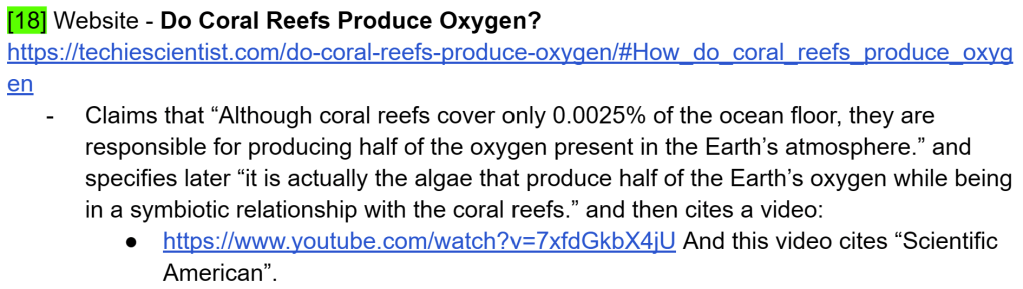
Honestly, let’s just leave it at that for now…
Conclusion
I’m honestly exhausted from just writing about my experience with this project. As someone with little knowledge of oceanography, let alone not pursuing a career in this sort of research (English Major), it’s extremely challenging to tackle such a large-scale project. I’ve seen many videos and articles outlining the benefits of coral conservation. They had professionals to support them, which is enough for accurate epideictic discourse. Why do I need to get involved?
I personally believe a very fundamental issue with the world is complacency. While it may be therapeutic- extremely beneficial at times- many conflicting ideologies and perspectives may be imbalanced with the amount of diversity they allow. You may avoid certain conversations with certain people, or “leave it to the professionals”. An important aspect of communication is the unified understanding and desire to distribute information. Sometimes people don’t want to go to scientists for ideas, they look to people who don’t have certifications because they trust them. Additionally, scientists may be stuck in rhetorical attitudes that cause harm to society. And yes, I will eventually go deeper into this topic in the future. But I believe it’s necessary for all of us to make sure information is being distributed without “corrupted data”. We don’t know the extents of good or harm from the things we say. So for me, I try my best to get to know these ideas- get to know the people. Understand how harmful the things I say might be, how my impression of a certain field prevents it from progressing, and recognize that the many strings that influence the ecosystem of knowledge. If you want to read further on this perspective, check out Donna Haraway’s “Situated Knowledges”.
But in general, doing this helps me grow my empathy and understanding of people. It makes me want to talk to them about these things, learn from them, and share what I learn. It helps me develop my skills of communication- especially artistically. I understand how important art is in communicating these values. So, I hope my videos will eventually be completed- and I can see whether my animations, voice over, and whatever helps people to understand something they’re not familiar with. I hope I can understand them too.
So, I discussed briefly about how awful my approach to creating this video was. You can see how “off-track” I was in regards to research, and I especially revealed a lack of understanding on these topics in general. Is it necessary for me to do all these- despite everything I said about the importance of communication? Well, discourse is the key. While I won’t necessarily be able to control how people perceive what I communicate, I want to emphasize fundamental aspect of information as discourse, as situated knowledges. I’m not saying “this is how it is”, I’m saying “I think this is how it is, this is where my ideas come from, so what do you think?” For this project, my intention is to be less of an influencer and more of a source of discourse. Yes, really ambitious! But perhaps a start is to create “discussion” videos in addition to the main presentation, and especially COLLABORATE.
Anyways, thank you for reading. I know there’s more to talk about in regards to my intentions and the logistics. I’m “brain-dead” now, so I’d like to put more effort into making the videos and experimenting rather than write this random “I’m trying my best” blog post. But if you made it this far, please let me know your ideas! I hope you got a sense of my progress so far!
Citations
[1] American Lobotomy: A Rhetorical History by Jenell Johnson (2015)
- Quote taken from “Chapter 2: Domesticated Women and Docile Boys: Lobotomy and Gender in the Popular Press, 1936–1955”.
[2] Why sharks matter – with David Shiffman
- A great talk about the state of sharks and the efforts of their conservation.
[4] Coral Reef Information System (NOAA)
[5] A BAD ROMANCE-CLIMATE CHANGE CREATES TOXIC RELATIONSHIP IN CORAL
[6] “A narrow Fellow in the Grass” by Emily Dickinson (Poetry Foundation)
[7] Fear and loathing of the deep ocean: why don’t people care about the deep sea?
[8] 5 Essential Roles That Roaches Serve in the Environment
- There are many studies and websites that cover the topic of the benefits of cockroaches, but here’s a start if you want to read up on it. My only issue is that they don’t have any sources to refer to. If I ever do a video about cockroaches, I’ll be sure to look for primary sources. This one’s an easy read for a quick knowledge bite.
[9] The Deep-Sea Podcast Episode 04 – Fear of the deep sea with Glenn Singleman
- Quote at 49:00 “I mean if there’s ever an alien looking animal on this planet, surely a coral is one of them.” Totally didn’t cite this just to recommend this podcast… But while we’re at it, this podcast is about the deep sea! It’s run by Dr. Thomas D. Linley and Dr Alan J. Jamieson. If you want to learn something new with two charismatic deep sea experts, go ahead and check out some of their episodes!
[10] The effectiveness of coral reefs for coastal hazard risk reduction and adaptation
- A scientific literature analysis on papers covering the topics of coastal defences (economically, ecologically, effectiveness, etc) comparing reef and artificial systems. This is a great overview of the information we’re currently aware of regarding coral reefs as the great “wave reductionists” they seem to be, and additionally a great awareness piece on increasing this area of study. My research on the topic of coral reef wave attenuation began here!
[11] Ecological consequences of major hydrodynamic disturbances on coral reefs
- Created a framework to predict whole-colony dislodgement of corals caused by hydrodynamic force. Because reef substrate is substantially weaker than coral skeleton (particularly for morphologies prone to hydrodynamic dislodgement), the capacity to resist dislodgment by a hydrodynamic force is generally limited by the tensile strength of the reef substrate. Therefore, if the basal tensile stress produced by a hydrodynamic event exceeds the substrate strength, dislodgement is expected.
[12] Resilience to large-scale disturbance in coral and fish assemblages on the Great Barrier Reef
- This study observes tens of kms of reefs in 14 years with the current theory of nonequilibrium theory, intermediate disturbance theory, to give evidence of coral ecosystem’s resilience. Hierarchical patch dynamics, landscape ecology, or metapopulation dynamics.
[13] High frequency of `super-cyclones’ along the Great Barrier Reef over the past 5,000 years
- A paper determining the intensity of prehistoric tropical cyclones over the past 5000 years of features that occur along 1500km of the Great Barrier Reef and the Gulf of Carpentaria, Australia.
- This study uses data from the 1998 El nino bleaching event (studying 14 fringing reefs in the granitic Seychelles) to predict the effects of coral loss on shoreline protection from waves and the recovery/accretion of coral. It outlines the properties of fringing reefs that provide a layer of attenuation.
[15] Seychelles: post-tsunami environmental assessment
- The previous study didn’t examine the on-sight impacts of wave energy, so I found this assessment of the late 2004 tsunami impact (conducted by the Seychelles Government the month after). Re-read to investigate damages the tsunami caused.
- Simulated 28250 possible scenarios with and without pit on a cross-shore transect of a fringing reef. They use data based on previous research to simulate the results through a “wave‐resolving model XBnh+”. They suggest that a full on-site research be conducted in order to validate the results.
[17] Coral Mining at Mafia Island, Tanzania: A Management Dilemma
- The effects of species abundance and diversity from mining coral. Includes statistical information regarding the amount of coral mined and economic values. Also an overview on the conversion between coral to limestone (lime production).
[18] Environmental Economics of Coral Reef Destruction in Sri Lanka
- Costs of coral mining versus economic values and effects in Sri Lanka. I like the quote at the end: “Those who benefit from short-sighted nonsustainable resource use must therefore be identified and targeted by management action.” TARGETED!!!!
[19] The importance of structural complexity in coral reef ecosystems
- A literature review on the value of structurally complex coral reef systems. Overall, the complex structure of reefs allowed for greater fish abundance and diversity. Urchins and algae, however, had a mixed to negative relationship.
[20] Octopuses punch fishes during collaborative interspecific hunting events
- Collaboration between interspecific species and the punches thrown by an angry octopus.
[21] Animal behaviour: Inside the cunning, caring and greedy minds of fish.
- Interesting relationship between predators in reefs. There’s also a cool video on the topic by the researchers: https://www.youtube.com/watch?v=giNH6oHPGmw
[22] A Global Estimate of the Number of Coral Reef Fishers
- 6.1 million world wide; represent about 2% of the 275 million people who live within 30 km of reefs around the world; Southeast Asia had the highest number of reef fishers (3.35 million), followed by the Indian Ocean (1.5 million). The Middle East had the lowest number of reef fishers (344,459); Indonesia was the country with the highest number of reef fishers (1.7 million), and was the only country where reef fishers exceeded a million. India and the Philippines had the next two highest populations of reef fishers, with 959,000, and 912,000, respectively.
- The 6 million reef fishers estimated here make up around 28% of the 22 million small-scale fishers globally.
[23] Contribution of marine fisheries to worldwide employment
- A calculation of the amount of employed marine fishers in the world from 144 coastal nations. Numbers: 260 ± 6 million people in total; 22 ± 0.45 million in small scale fishers, 203 ± 34 million full time equivalent fishers, 50 million in primary production sectors.
[24] Mapping the global value and distribution of coral reef tourism
- A global estimate of over 100 countries containing coral reef tourism values. Calculations considered reef-adjacent activities such as food, views, and sandy beaches along with on-reef activities such as diving and snorkelling. The range of coastal tourism was within 30 km (excluding urban areas), resulting in a total of US$36 billion globally, 70 million visitors, or over 9% of all coastal tourism value in the world’s coral reef countries.
- Additionally conflicting data such as tourism numbers not comparable to studies I’ve found. “$11.5 billion in tourism” while I found $36 billion. And estimated shoreline protection values are higher than what I found: https://files.wri.org/s3fs-public/pdf/reefs_at_risk_revisited.pdf – page 92.
[25] The global flood protection savings protection by coral reef
- Conflicting data regarding coastal reefs: this paper states “Across reef coastlines (71,000 km)” while other sources suggest the number is larger “Reefs protect an estimated 150,000 km of shoreline in more than 100 countries and territories.” The source of this conflicting data comes from Reefs at Risk Revisited by Lauretta Burke, Kathleen Reytar, Mark Spalding, and Allison Perry. However, they also collected this data from another source.
- Example website: https://resourcewatch.org/dashboards/coral-reefs
[26] How Many Species Are There on Earth and in the Ocean?
- Using taxonomic patterns, an estimated 8.74 million eukaryotic species were predicted along with 10100 prokaryotes; 2.21 million marine species, 298 thousand from the plantae domain, etc. “86% of existing species on Earth and 91% of species in the ocean still await description.” Previous estimates ranged from 1-100 million, however this approach allows for a narrower prediction. The problems with this approach is incompleteness of data and the use of synonyms in taxonomy.
[27] Species Richness on Coral Reefs and the Pursuit of Convergent Global Estimates
- An estimated 830000 multicellular species (excluding fungi) in the world’s coral reefs. Uncertainties in estimates are believed to lean towards greater numbers of species- so future studies should discover more than 8 hundred thousand. “Less than 9% of all multi-cellular species on coral reefs have been named, an additional ~13% have been discovered but not named, and ~74% of species remain to be discovered.”
[28] Biomedical Potential of Marine Natural Products
- Summary of the bioprospecting studies regarding marine organisms. There is a section for cnidarians, which I used for information regarding coral species.
[29] Natural coral exoskeleton as a bone graft substitute: A review
- A literature review of coral as a bone graft substitute. There is a lot of literature surrounding this area of study- 30 years in total that this paper reviewed. Instead of looking at each paper individually, I relied on this summary for quick and concise information. I typically look at their sources, but bruh… 100+ citations for extra detail that I’m not going to use.


Leave a comment