Introduction – Preface
As a University student in the Arts program, I’m required to take a language course to fulfill my requirements. And this was something that was genuinely an area of interest for me: as a self-proclaimed otaku of North American back in 2020, I obviously would take Japanese. That year (2020) is important, however, as it was when COVID-19 struck the world with a flurry of… inconvenience. “Inconvenience”, yeah that word. I don’t know, I kind of like using it to formally apologize in emails: “I apologize for the inconvenience.” Whether it prompts my professors to provide me with an extension is another question. It surely didn’t work back then.
Online language learning, especially for a language like Japanese, especially for someone only familiar with his ABCs… my god, I just had an awful time. And it’s a fun story for another time, but of course, I wasn’t able to continue. While my grades were sufficient enough to pass the course, they were too low to continue to the next levels. I needed to complete a language course up to it’s intermediate level: 4 courses in total, 2 years. Japanese was out of the question unfortunately (although I can somewhat read Hiragana and Katana still), so I had a couple options. I believe there was German, French, Spanish, Korean, and Latin. Also Old English- interesting… No, I don’t think Latin and Old English were a part of the requirements. But there was also another language: Swedish.
Many articles discussing language learning pointed to Swedish as an easy new language for native English speakers. Surely, it would go well for me too, then? My interest in the other options were limited, so I was open to absolutely anything. And this month I had completed the immediate course for Swedish. Yes, I can read and understand Swedish to… some extent. But my language journey isn’t the focus of this blog post.
Participation is a crucial thing for language learning. Of course, I recognize that- but… I also have quite the social anxiety. It’s very difficult to get out of my room and go to campus for an hour of Swedish socialization. I believe this aspect of anxiety is “anticipatory”- there’s something I’m constantly fearing before it occurs, if at all. And this typically inhibits my various obligations and desires anywhere from volunteering to speak in-class to sending a text message to a friend. So, what was I to do to ensure that I get at least some participation marks? Yes, “some”- I would generally sacrifice my grades, even if the participation is like 20% of the final grade…
Since the course is had this thing called “canvas” to submit assignments and communicate material, there’s a discussion board for sharing whatever Swedish-related thing with the rest of the class. This was potentially a great place to start discussion without interacting face-to-face. Oh my looord, an escape from my problems! I actually love socializing, but it’s very difficult to maintain my energy when face-to-face. If given the chance, I’d generally have no problem speaking about a variety of subjects and act all extraverted for a couple hours. It’s generally no problem- if I wasn’t additionally in a constant state of worry. Perhaps a plethora of experiences compounded upon my anxiety, reinforcing a delusion that anticipates various outcomes- emphasizing and assuming the worse. And it’s interesting to wonder about the nature of this, especially when reading about certain depictions of socialization. Slice-of-life literature provide such an interesting look into the perspective of characters as they socialize- particularly Jane Eyre and Adachi to Shimamura, which I’m currently indulged in. But, I’ll discuss more about those stories another time.
So, I wanted to share! Something of a bad habit regarding my academic studies is… well, I take the content and don’t apply them to the course. An example would be my behaviour in my 19th Century Victorian Literature and Rhetoric of Science and Medicine, where I gathered and studied various aspects of the content for fun, but forgot to do the assignments that those material were intended for. For the Swedish courses, I explored it’s linguistics and etymology, especially Swedish history, but completely neglected my actual academic roadmap. Well, I didn’t completely abandon it, but I definitely prefer to go off on my own. Which is where the Swedish final project comes in. At the end of each course (1 course of Swedish each term), we have a final project where we communicate an interesting aspect of Swedish culture. Last semester I worked on the Swedish poet Bruno K. Öijer. But this term, I had like 5 project ideas… One of them was on Hnefatafl.
Since my participation marks were non-existent, I decided to write a little discussion post to communicate one of my project ideas. It is mostly in English as it’ll be rough to write it all in Swedish, but it didn’t matter too much as it was a mere discussion post… which no one used. Actually, I don’t think anyone but my professor read it! And she only read it because I told her about it. So, it’s lingering there, waiting for eyes… But ehhh, I hope you enjoy it somewhat. I’m not going to translate any of the Swedish I wrote since it might be fun for you to try to interpret it. My Swedish professor on our first day literally came in speaking Swedish, and almost everyone understood what she said! How about that? You can try to figure it out too! If you can’t, it doesn’t really matter. They’re just short little expressions which have nothing to do with the content.
Anyways, enjoy!
Hnefatafl
Hej alla! Jag har läst mycket om Sveriges geografi. Everything from the North American and European continental plates colliding to form the Caledonian Mountains (500 and 370 million years ago), to the crater ring of Lake Siljan in Dalarna (3km-wide fireball hurtled into Sweden 360 million years ago- creating a 75km ring-shaped crater), och min personliga favorit… post-glacial rebound! Men vad betyder det?
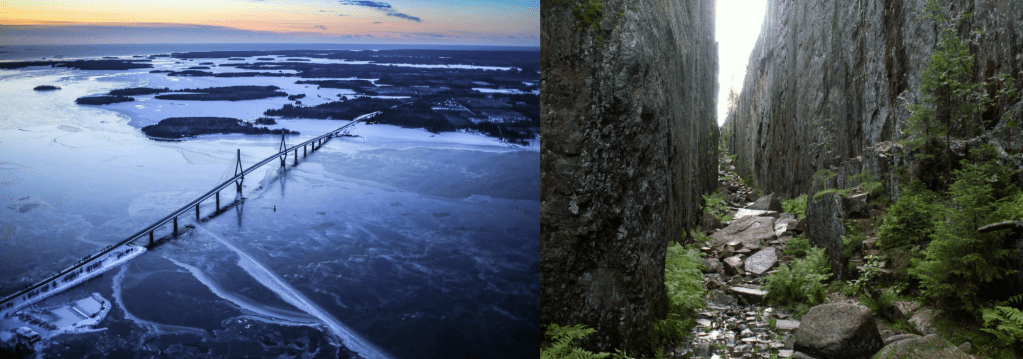
Around 10,000 years ago at the end of the last ice age, the Scandinavian ice sheets melted uncovering a plethora of previously unusable land. Hunters followed the reindeers into this new area now recognized as Sverige. But this event didn’t come without its geographic consequences. The sudden weight loss upon the tectonic plates resulted in isostatic rebound, an uplift of the lithosphere by the partial melting in the aesthenosphere. The best demonstration of this phenomena occurs in Sweden’s (in Västernorrland) and Finland’s shared UNESCO World Heritage Site: Kvarkens skärgård. Here the average seafloor elevation is incredibly shallow (mean depth less than 10 m) due to isostatic rebound. The uplift has been presently measured at 8 to 8.5mm per year, with a prediction that it’ll continue for another 10,000-12,500 years in the Kvarken area (possibly up to 100 and 125 metres more).
The characteristic islands of the skärgård we see is a result of the post-glacial rebound with many new islands appearing from below. With the current rate of uplift, we can predict that there will be a bridge between Sweden and Finland one day! Similarly along Sweden’s coast (of Ångermanland), the Höga Kusten is also a result of rebound- but with the coast rising faster than the oceanic plates.
Titta ner söderut, det finns mer! West of Stockholm, there lies the World Heritage Site; the islands of Lake Mälaren, burial and trading centre of the Svea people. By the 7th century AD, they had gained supremacy and called their kingdom Svea Rike, or Sverige- yes, that’s where the name came from! They founded Birka around 760 AD on Björkö (an island in Mälaren lake) and was a powerful Svea centre for around 200 years. Interestingly, the Benedictine monk Ansgar was also sent to Birka by the Holy Roman Emperor to convert these Vikings to Christianity in ~830 AD.
This area is an interesting place to settle for these Vikings as it’s geological activity is yet to be inactive for the coming thousands of years. Similar to Kvarken and Höga Kusten, isostatic rebound also occurs here at a lesser rate. It’s average depth is 13m, going as far as 64m, and apparently it used to be a bay! In North America, it seems like something similar has been occurring on the West coast of Hudson Bay. But where once described as “the ultimate Viking warrior grave”, on the lap of a deceased female military commander of the Vikings in Mälaren, dressed in her finery, along with her horses, her weapons, her fellow elite military commanders… well, what did you expect? It was a board game!
I’ve been invested in these sorts of tactical board games for a couple years, but we’ve all heard about them since the conception of our fascination with games. In Asia, there are a couple popular games such as Go, Shogi, and Xiangqi. Worldwide there are countless of local and culturally relevant games. But we’ve all heard of chess, schack. It’s the ultimate reference when considering the art of war. It’s been played and studied in the hopes of a morning when we all see on the news: “Chess has been solved!”
Generally, this end-goal isn’t necessarily impossible. From certain opening positions to any variation of a board consisting of 7 pieces- it’s been solved, we know who will win. After all, these games are a closed-system with defined rules and limitations. But chess has yet to recede from it’s cultural relevance with the modern world. That’s because the battle doesn’t exist purely on the board. With the development of powerful computers, perhaps these limited tactical games may fall stale? It makes sense, but it hasn’t. Our interest in these games aren’t because they seem to intrinsically have unlimited possibilities, but because we’re the ones playing them- perhaps with various rules, for various goals. And in the battle of board games, where is Hnefatafl? How are we playing Hnefatafl? What are the rules of the game? Why do we play it?
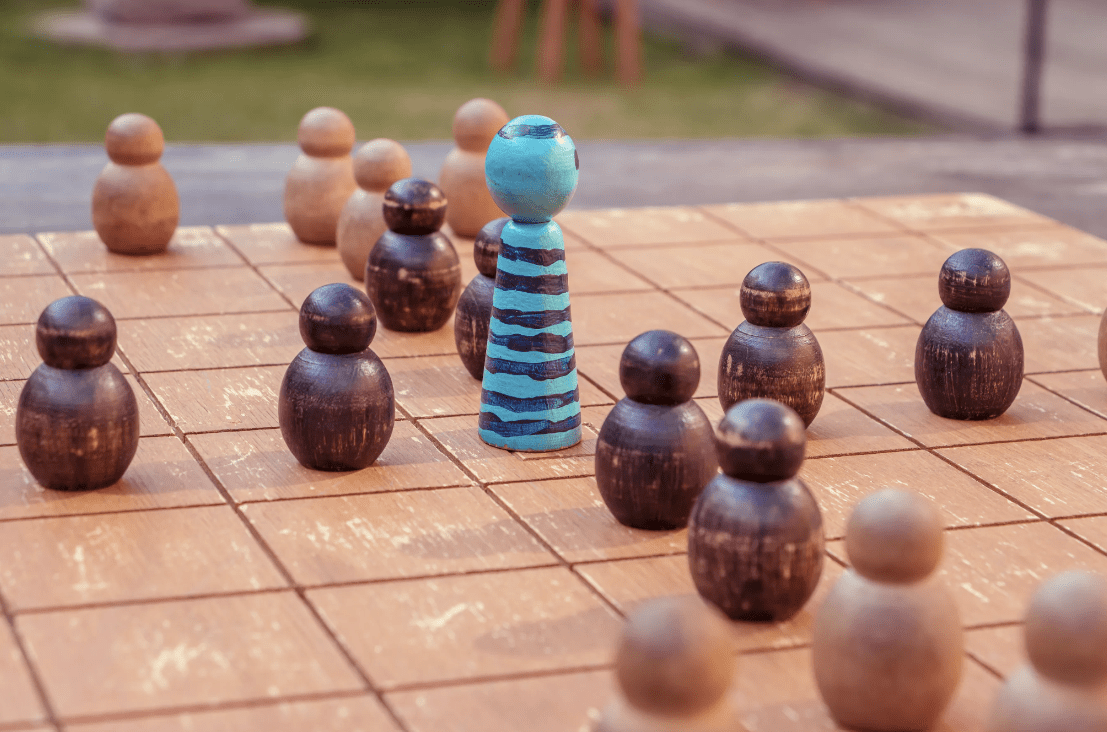
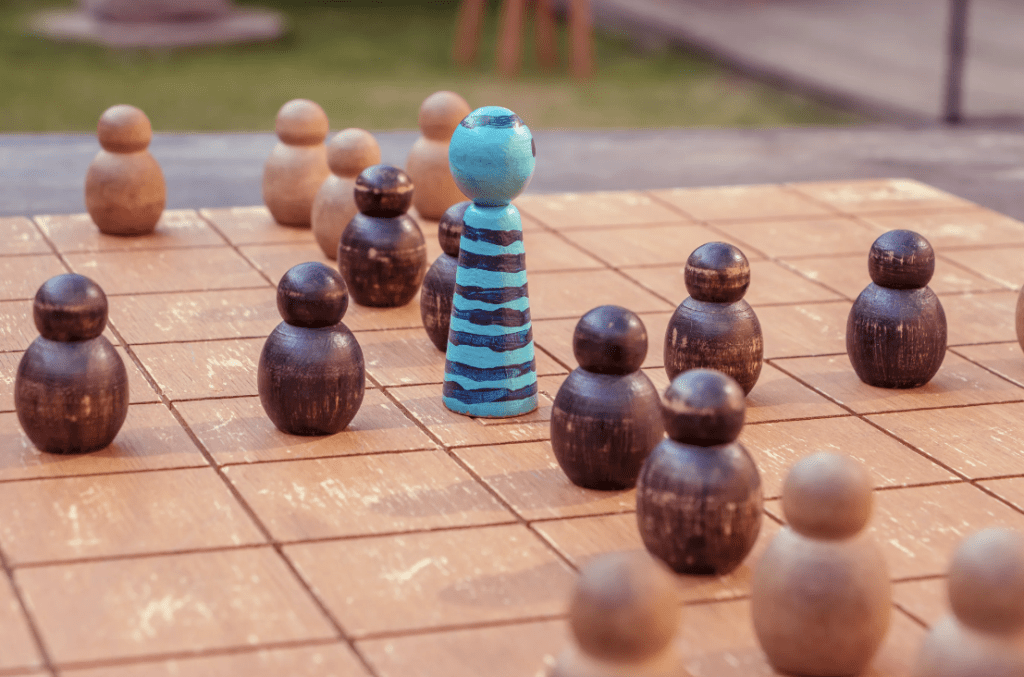
You probably haven’t heard of this obscure game board game before (it’s the image above). “Hnefatafl”, board game of the fist, a particularly popular “tafl” game, with “tafl” simply meaning “table” in Old Norse”. It’s a war game with distinct objectives for two opponents. You either play as an attacker or a defender/escaper. One side has a king and multiple pawns, the other only has pawns. In the picture above, you can see how the board is orientated. From a starting position, the defender/escaping side is in the center while the attacker surrounds them. A fascinating craft of the Vikings!
Through various forms of exchanges ranging from peaceful trading to dominating raids, this game was distributed to many parts of Europe. As with any popular tactical game of ancient times, good gameplay was perceived as a quality befitting kings and nobility, particularly intelligence. Although I will add Paul Morphy’s famous quote “The ability to play chess is the sign of a gentleman. The ability to play chess well is the sign of a wasted life.” Well, the arguably most talented chess player in history said that! But regardless, that’s how these “intellectual games” were viewed (and still is today). And with Tafl, it wasn’t only played by the wealthy and noble, but by the Sami people and anyone who had a board around. Of course, women played too! Although the literature seemed to have been suspicious if they were too good. If they didn’t have a board around, well… du kan bara göra en! In Scotland, DIY boards were discovered scratched onto slate rocks. Over in Ireland, pieces were kept steady on a board by fitting pegs into holes so the crew could play on the waters. And on my computer, I can play online! Easy!
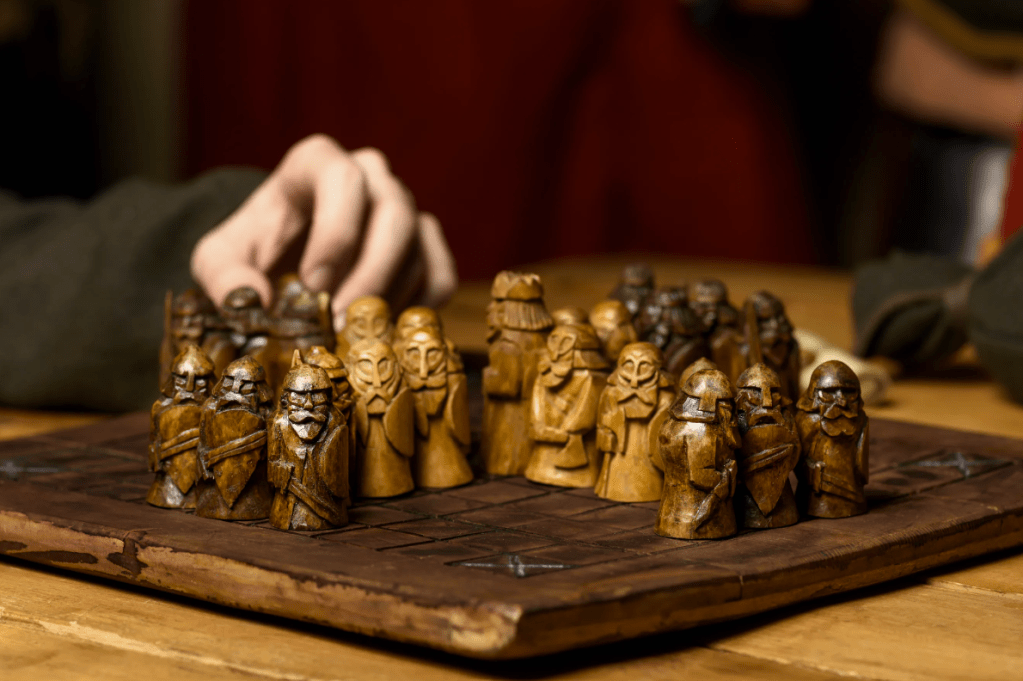
Would you be surprised to know that this ancient game of immense popularity had died out soon after the introduction of chess to Europe? “Chess certainly wiped out a lot of games,” says Martha Bayless (Ph.D. in Anglo-Saxon, Norse, and Celtic from Cambridge University). “Tafl was a war game, as is chess, so they fit into a similar space in culture. The other very popular early medieval game was a form of backgammon, which is a racing game, and that game continued strong all the way through, as we can see by the fact that people still play backgammon to this day. So it was in the realm of war games that tafl lost out to chess.” And there are many theories regarding the domination of chess. Bayless suggests that the pacing of the game may have contributed to chess’ success. It wasn’t as long as a shogi game, and it wasn’t as quick as a game of Hnefatafl. “It developed a reputation as a game where men and women could flirt, maybe because it did take quite a lot of time to play,” says Bayless. Just enough time to pull out a few chess puns for romantic tension (warning: don’t search this up).
Personally as a chess and shogi player, I have my own suspicions regarding Hnefatafl’s intrinsic gameplay. It’s not symmetrical: One of the most prominent tactics in chess is creating complexities on the board. This is intuitively the progression of the game as the starting positions are completely symmetrical. If you were to make two powerful chess engines play a game, they’d always end in a draw (provided you gave them the starting position). Chess itself at the objective level is a draw. But for humans, that’s not the case. The current study of top-level chess is the use of engines to analyze the potential of specific positions and openings (which tend to be asymmetrical). For example, the Scandinavian defense is rarely played at the top-level because it lacks advantages (I’m sorry Scandinavia…). And if top players wanted to end a game in a draw, they’d simply need to play into a variation of the Berlin opening. Still, there are various openings that make the gameplay intrinsically interesting even now. But this is why Hnefatafl may be difficult at a competitive level. It’s immediate asymmetry provides the game with too much immediate variation. You don’t build the structure of the London system like you do in chess, Hnefatafl forces each side into a specific and defined position immediately. And if computers were to get involved, there may be a clear advantage for either the attacker or defender. Look to the games Connect Four and Chopsticks, for example. For these two games, the first player will always win if they make the best decisions (regardless of the opponent). The game is fundamentally too imbalanced for competitive appeal.
I imagine the Vikings created this game to represent the environment and situations they often encounter. It was a simulation of war, after all. The fact that there’s a clear defender whose goal is to escort the king to the corners of the board, and there’s an attacker whose goal is to prevent that- reveals a lot about the nature of the game creators. There aren’t just two kingdoms, there is a situation. In chess, it isn’t as clearly defined- although at the human level, white has the advantage of the opening move (the concept of tempo). But if Hnefatafl were to become competitive, it wouldn’t have the luxury that chess has.
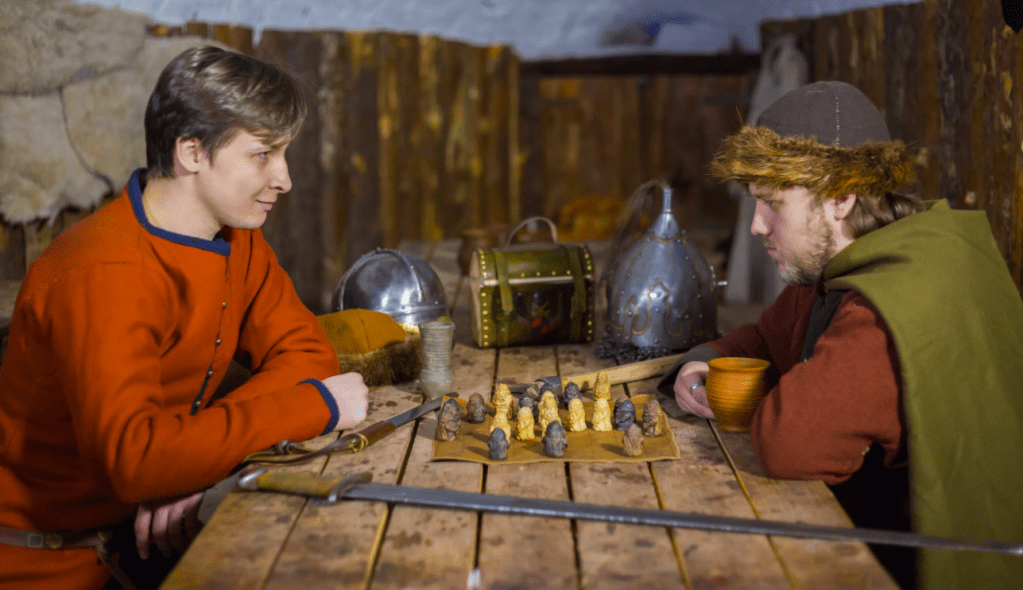
Varför spelar vi spel? This is an interesting question. Games have often been associated with certain societal ideals. Sometimes they’re romanticized as a sign of intelligence, other times they’re a sign of youthful ignorance. We’ve crossed the boundaries of the perceived heavens, brought back the stories lost in time, and yet regardless of the associations we’ve placed on them- whether simpler than rock-paper-scissors or as complex as romance, we still play them. And we continue to push the rigid categories of what defines a game.
I didn’t mention this, but we don’t know the rules of Hnefatafl. There are only two accounts of the rules of the game: One comes from Welsh, whereas the other is from an account penned by the Swedish botanist Linnaeus, who watched the Sámi play it but didn’t understand their language. “The last record of tafl being played as part of the long tradition, rather than part of a revival, was in 1889, among the Sámi,” says Bayless. “So recent, comparatively speaking. How I wish someone had asked those players what the rules were!” As of now, there are countless variations of the rules. Some spawned in large communities, others possibly within a small family.
If I’ve lessened your hopes regarding the game of Hnefatafl by comparing it to the success of chess, I’d like you to consider the goal of playing games. Not just playing it, but learning it. Uncovering it’s histories and stories. There’s a reason I studied the World Championship games between Bobby Fischer and Boris Spassky. Let me tell you: it wasn’t just because they were top-level games. It wasn’t just because I was intrinsically interested in the game of chess. And consider this with the current attempts at uncovering the mysteries of Hnefatafl. Consider this with the current state of the game. Even if it’s rules aren’t clear, we have the board and we have the pieces. The world is chaotic, but games are a way to set a goal and direction to traverse towards somewhere over the hill, over the waters, or into between the spaces of uncertain times. Maybe the goal isn’t only just to be competitive or intrinsically interesting, nor lead a perspective of productivity? Sometimes the simple vague interest in a game may lead to uncovering a vast history of a forgotten entertainment? Perhaps it may act as a vehicle for social fulfillment? And with a game with no rules, maybe when we play, we can decide on them together?
“In the Old Norse Vӧluspá, the mythic text that describes the creation of the world, the gods participate in tafl games as if doing so is their way of structuring the world and continue to play until they are interrupted by evil beings. At Ragnarok, when the end of days brings about a new tomorrow, the tafl pieces will once again be found in the grass, allowing the world to be made anew” – Bayless.
Works Cited
[1] Lake Mälaren | lake, Sweden | Britannica
[2] Remembering Hnefatafl, the 1,000-year-old Viking board game murdered by chess (inverse.com)
[3] HIGH COAST / KVARKEN ARCHIPELAGO – World Heritage Datasheet (unep-wcmc.org)
[4] SWEDEN 4ED -ANGLAIS-: OHLSEN,BECKY, BONETTO,CRISTIAN: 9781741047752: Books – Amazon.ca
[5] Sweden – Up North, Down to Earth by Swedish Institute – Issuu


Leave a comment