
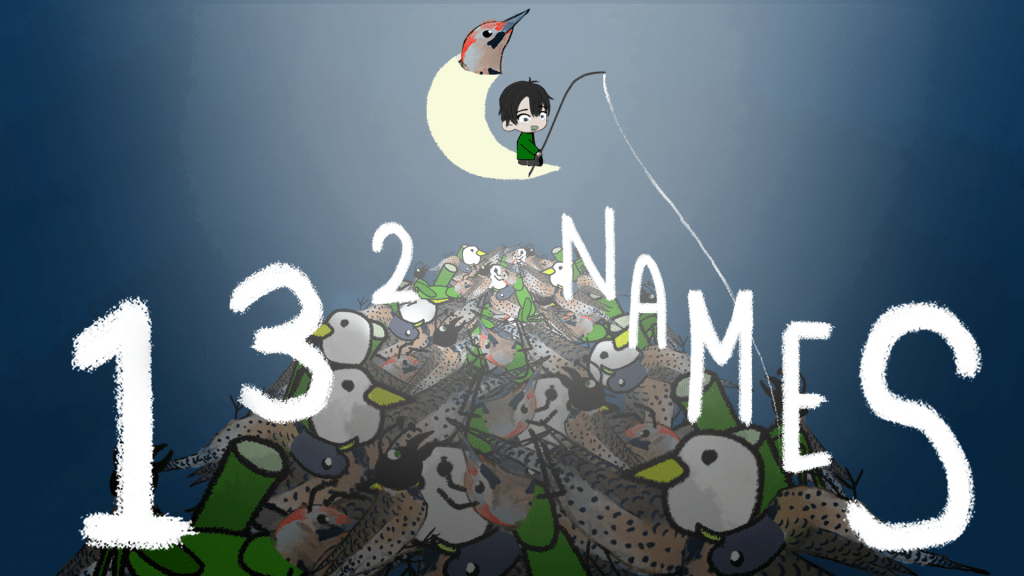
Video: https://youtu.be/yjdiCzd8ZMA
Full Script with Citations
This bird has 132 common names! Really? Are you sure about that? Where’s your source?
Anyways, there are a couple of facts many websites repeat: the northern flicker eats 5000 ants, they have weak bills, they are monogamous… almost all of them have like… no source nor nuance.
But the 132 common names are different, they actually have a resemblance of a source.
Look at this website:
It [1] mentions: clape, gaffer woodpecker, high-hole, partridge woodpecker, and yarrup.
Okay, so 5 different names. They’re demonstrating their knowledge, so they must know the source… right?
Let’s look at this other website [2]:
Yellowhammer, clape, gaffer woodpecker, harry-wicket, heigh-ho, wake-up, walk-up, wick-up, yarrup, and gawker bird.
10 names, but… some of them overlap with the previous website.
Next website [6]:
Yellowhammer, clape, gaffer woodpecker, harry-wicket, heigh-ho, wake-up, walk-up, wick-up, yarrup, and gawker bird.
Bruh, this is the same thing. Wait, it’s an entirely different website? Umm… okay next?
Hopefully this next website [3] gives us some new names:
Yellowhammer, harry-wicket, clape, gaffer woodpecker, heigh-ho, walk-up, wake-up, wick-up, yarrup, and gawker bird.
Okay what the heck? Are you seeing this? They have the same names as the previous website, just ordered around differently!
Okay last website… [4]:
clape, gaffer woodpecker, harry-wicket, heigh-ho, wake-up, walk-up, wick-up, yarrup, and gawker bird.
They just repeated the same names!
In total, these websites demonstrated that they only know 12 different names. According to my math, that’s 9% of the total names – and I looked at 5 websites! Are you telling me that these websites don’t know the rest of the names?
| Name | Times Repeated |
| Clape | 5 |
| Gaffer woodpecker | 5 |
| High-hole | 0 |
| Partridge Woodpecker | 0 |
| Yarrup | 5 |
| Yellowhammer | 3 |
| Harry-wicket | 3 |
| Heigh-ho | 4 |
| Wake-up | 4 |
| Walk-up | 4 |
| Wick-up | 4 |
| Gawkerbird | 4 |
Plus, some of them are basically the same: like “wake-up”, “walk-up”, and “wick-up” – bruh, you can’t be serious. And “high-hole” and “heigh-ho” – oh my god.
I imagine a northern flicker flying around doing its “call” (northern flicker call “wick wick wick”), and people are like…
- “Did it just say “wake-up”?”
- “Nah it said “walk-up”!”
- “Come on bruh, I think it said “wick-up”…”
Bruh, I bet this actually happened.
Anyways, one of the sources was Wikipedia [2], and it was the only page that had a direct source to the fact [5]. Just kidding – what the heck is this source? Wikipedia – why have you sent me to this broken looking website??? They told me nothing new about the common names – nothing!!
Ughhh… Okay, if you say 132 names, I want to know all of them. I don’t doubt anyone saying that northern flickers have 132 common names. But what are they? Seriously, I want to know! So I searched and searched – I won’t bother you with the details. To get to the point, I found it. I found the original source, I think… Here it is: “Franklin L. Burns (1900), in his monograph of the species, lists 123 such names; and later he adds nine more, bringing the list up to 132 names” [7].
If I look into my magical red book, I can find Burns (1900). And yeah, here it is! The first 124 common names are listed starting on page 5.
There were a lot of interesting names, some of them are repeated in the same fashion as “wake-up”, “walk-up”, and “wick-up”. But there were some that were pretty cool and funny. Here are some of the names I personally liked:
- Antbird
- Cave-duc (from ignorance)
- Crescent-bird
- Grasshopper-woodpecker
- Hammer-Head
- Pigeon-woodpecker
- Sucker
But these are just a couple of names gathered from all sorts of sources, both general and local. What about more formal classifications? Within Burns 1900, there are actually a lot of discussions on the role of vernaculars and the history of the northern flicker’s scientific name.
I mean, look at this: The origins of the northern flicker’s scientific name began with Catesby’s long descriptive name in 1731, then Klein in 1750 incorrectly placed it in the genus designated for cuckoos, then the famous Linnaeus in his 1758 “Systema Naturae”, and so-on.
| Picus varius major alis aureis from Catesby (1731) |
| Cuculus alis deauratis from Klein (1750) |
| Cuculus auratus from Linnaeus (1758) |
| Colaptes auratus from Swainson (1827) |
But at the end of the day, I got what I wanted: more than just the same 12 names. No, I’m not satisfied… I’ve got more questions: Like, is it even surprising that the northern flicker has so many common names? Because… I bet some species have just as many or even more names. And I just looked it up: The puma has over 40 names according to Guinness World Records [8]. They don’t show how they got that number, but honestly – probably depends on what they even consider a name. Maybe it’s hard to define a standard verification for a common name?
So then… Why is the northern flicker’s 132 common names so significant that websites highlighted it? Seriously, this number is almost like a joke…
I think it’s because… it just turns out that Burns in 1900 wrote all the names down, verified them based on his own standards, and published it. And he didn’t even intend to make this compilation of names, but decided to add it later as evidence for a greater point: that the northern flicker was lucky to not have a prefixed personal name like “Steller’s Jay”, or “Cooper’s Hawk” – like who are these guys who self-inserted themselves here? Bruh.
And also, he wanted to highlight that common names attributed to the bird were based on 3 divisions of representation: descriptive, onomatopoetic, and misnomers. He wanted to show that northern flickers had many unique characteristics, and thus so many different names to describe them as a result. The case to prove these characteristics led him to catalog over 100 names. Like, why else would he take on such a task?
Well… he actually gave an answer: he did it because he wanted to share it – for the sake of providing an easy resource that isn’t as intimidating as the magnitude of literature under the title of a single species. A lot of information is scattered everywhere, made irrelevant because it’s not attached to anything. The only value the 132 common name has, as demonstrated by the websites, is that it’s a “fun fact”. The fascination starts and ends at the relatively large number, along with the 40 names attributed to the puma [8]. Like, what’s even the nuance to it? Does it matter that it has so many names? The answers to these questions are lost to this obscure book from 120 years ago.
For me personally, I can relate to Burn’s desire to do something because “the demand for complete life histories of even our most familiar birds have not lessened to any great extent”. I think for him, sharing information is just so valuable. And especially sharing it with context. This number [132] is nothing without the context that it demonstrates a common tendency to name things based on certain traits, that northern flickers have a variety of unique recognizable traits, and that it breaks the mold of prefixed personal names.
This whole video was to show that a lot of websites are not wrong – they have information derived from real sources and they didn’t just make things up… of course, they just want to share information. I’m personally just sharing information too – showing my experience and opinions with the theme of sporadic learning. But here’s what I want to emphasize: If you want to know more about anything – you can. And if you do, please for the love of birds – if it’s not personal or confidential… share with us how you did it.
Citations
[1] Flickers | Radio | Laura Erickson’s For the Birds
[2] Northern flicker – Wikipedia
[3] 12 Interesting Facts About The Northern Flicker (birdchronicle.com)
[4] Northern Flicker – Pajarito Environmental Education Center (peecnature.org)
[6] Northern Flicker (Common Urban Nova Scotia Birds) · iNaturalist Canada
[7] #15 – The Wilson bulletin v.12 1900 no.31. – Full View | HathiTrust Digital Library
[8] Mammal with the most names | Guinness World Records
[9] Northern Flicker – American Bird Conservancy (abcbirds.org)
[10] Country Ecology: The Northern Flicker – Ossipee Lake Alliance
[11] Northern Flicker – Facts, Diet, Habitat & Pictures on Animalia.bio


Leave a comment