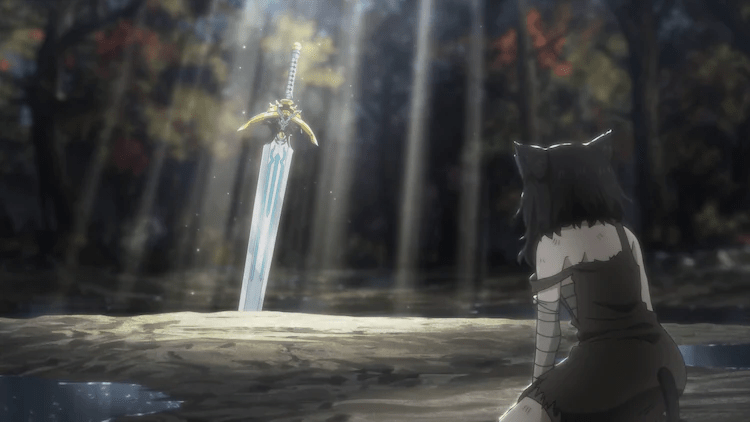
“For this is what your folk would call magic, I believe; though I do not understand clearly what they mean; and they seem to use the same word of the deceits of the Enemy. But this, if you will, is the magic of Galadriel. Did you not say that you wished to see Elf-magic?”
– Galadriel [Fellowship of the Ring – The Mirror of Galadriel]
The perspective on magic stems from various mysteries, from the association of divine majesty or witchcraft, to an eventual categorization of empirical science of elements that seemingly act as “inflammable air” (Henry Cavendish’s discovery of hydrogen). How would one necessarily describe magic, or perhaps anything foreign? If I were to tell you about certain skills I’ve developed through practice, a common interpretation of my ability would be intelligence or talent; an abstract concept we attempt to materialize. We may hear about dark matter’s mysterious invisible interactions with gravity, and we think about “harnessing the power to make black holes” (whatever that means). To put it bluntly, it’s a difficult process to build a framework that can interpret the unknown- as some like Galadriel from Lord of The Rings interprets “magic” as a foreign conception of something that’s… really quite a natural thing for her. She would consider it in a similar realm as the “magic of making chicken curry”. The Eldar of Valinor (light Elves), those who lived with the Gods of Middle Earth, of Eä- “magic” and interacting with Gods are just another part of their lives.
Side note: One of the Valar (one of the “Gods”) called Yavanna taught Galadriel to make lembas, a special travel food that I craved ever since I saw Merry and Pippin devour it.
Fantasy is quite a fascinating genre to explore with how much it reveals our interpretation of the world. Where do we draw the line between fiction and realism? How do what we make and talk about reveal our interpretations? But what prompted my desire to write about this topic was the light novel Reincarnated As A Sword. It presents various generic tropes of the isekai genre, where a character is summoned or reborn into a new world. And we’ve had numerous stories of this sort of plotline. Everywhere from Alice’s Adventures in Wonderland to the Matrix (yes, to some extent). An interesting commonality I’ve noticed when it comes to Japanese media, however, is how the new world operates. If we think about our “real world”, it’s a chaotic mess where governments and corporations attempt to establish order within the unknown mechanics of the cosmos. So far, we haven’t necessarily developed such a clear approach- despite categorizing systems of physics, mathematics, chemistry, politics, humanities, etc. There’s just so much that doesn’t make sense, so much that does- and that doesn’t make sense. We fall into a pit hole of objectivity or relativism, and everything between and outside- or beyond our metaphorical spatial mappings. But in the fictional universe of Japanese isekai, the “generic plot” is that the character(s) arrive in a world that makes sense. And something that makes “sense”, seemingly so simple: magic, specifically video-game-styled magic.
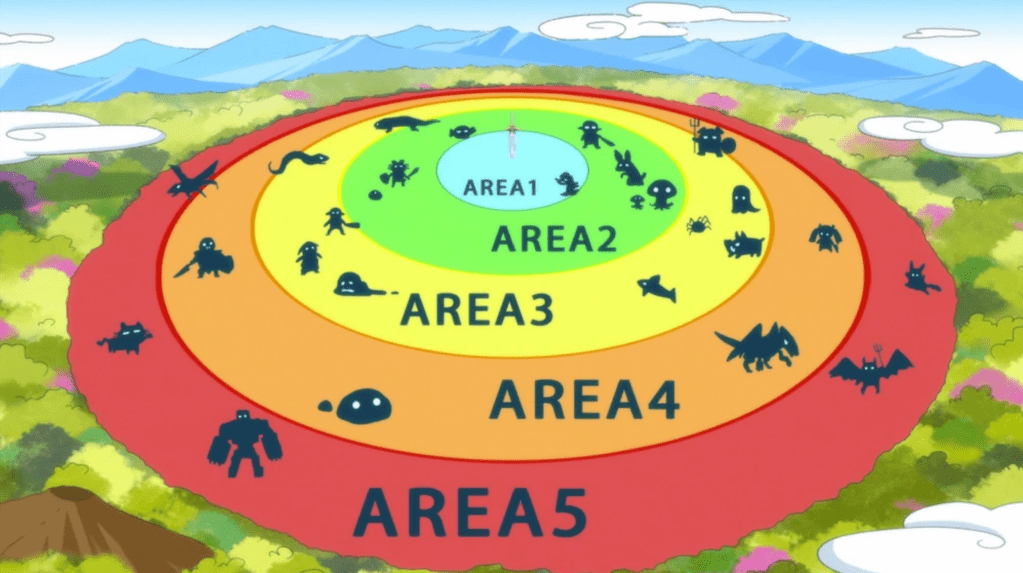
I’ll be focusing this brief discussion of the video game world on Reincarnated As A Sword, particularly the light novel up until volume 2 (as that’s where the anime ends, and I’ll pick this up after season 2), although there are numerous examples that provide exceptional discussion on the organization of the world as a game. I’m currently working on a video-animation where I take a dive into No Game No Life‘s philosophy regarding the common rhetoric of distinction between simplistic games and the chaotic world. It provides an ideology of flexibility in approaching life and establishing goals; a framework that incorporates our functions as goal orientated individuals and how we can create a collective goal in the realm of ambiguity (creating meaningful relationships). “What is meaningful”, “what is the goal”, “why do we live”??? The author, Yuu Kamiya, utilizes a world that “makes sense”, where objectivity exists due to the clear parameters and goals: establish relationships with all 16 races in order to challenge the One True God (basically collect all the pieces of your side of the chess board so you can play). There are clear rules that cannot be broken under the seal of the One True God- forced objectivity. These sorts of other-worldly, now morphed into a familiar-realm of isekai, is a fascinating genre that points to questions on how we can organize our world into a productive system. However, many issues inevitably arise with segregation and toxic rhetoric- which lead to a plethora of conflict. Similarly, a reality of ambiguity may prompt unproductive relativism where individuals and collectives aren’t held responsible for their actions. For further inquiries on interesting frameworks, check out Donna Haraway’s Situated Knowledges [1] approach- or provide any other approaches and discussion (I’ll be sure to check them out in the comments).
Some of the literature I’ve been exploring on the topic of “life as a game” are papers in favour of the idea, like Bernard Suits’ Is Life a Game We Are Playing? [2], and an article that rejects the idea by David Brooks on Is Life a Story or a Game? [3]. Personally, I find both approaches to perceive “games” in quite a defined manner- perhaps as academically desired. However, games have become further ambiguous with the development and integration of its aspects into our lives- or I would technically say that our categorial approach to defining it fails to do it justice. It existed before we desired to confine it to child’s play. Perhaps it’s the whole “art imitates life”, or Oscar Wilde’s flip of the idea: “life imitates art” [4]; we are influenced by these ideologies of games, limiting what a game can be. However, I’d like to continue reading through the literature for additional ideas (please provide some in the comments if you’d like), and this blog post is generally about the situation where games are established as a reality (either by societal actions or divine intervention). Or, what does that mean for the world to be a game? Does it have MMORPG elements, a health bar, power levels, a magic system? What is good and evil? Perhaps what’s similar about these parameters are that they are materializations of a mostly abstract concept? Things make a little more sense with a flick of God’s wrist.
“Did God really write those descriptions?”
How do we necessarily determine a “God” in the world? It’s quite difficult in our world, relying on various factors of communal agreement, empirical and spiritual evidence, codification… perhaps codification is a start? Ignoring the issues of genuine authorship, a “video game” has developers with designs made intentionally for direct communication. This usually comes in the form of the video game interface: descriptions, statistics, menu screen, etc. We can observe this in the anime:
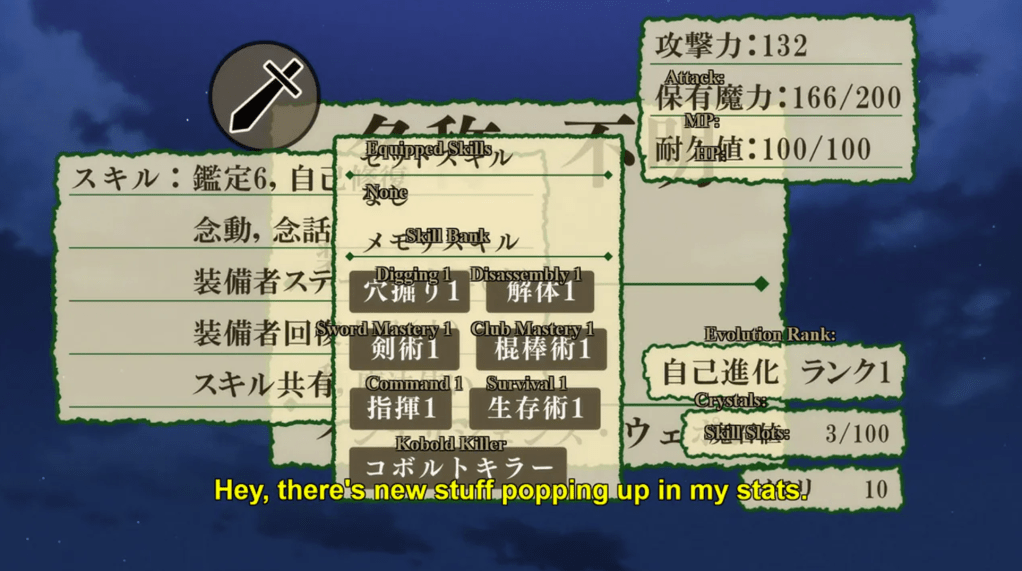
There are theories that debate about evolution and biological design- one could question whether it was necessarily “God” who developed this interface, perhaps it was a result of evolution (which… is a product of God’s design anyways)? As established in the narrative, there isn’t just one God, but a pantheon of distinct individuals categorized according to their roles and functions (“Chaos” God, for example). As the narrative develops, these questions will have further information that establishes an origin. However, let’s consider the situation where a creator (or multiple) developed this interface, provided the mechanics of the magic system, and wrote the descriptions of existence.
Note: Because there are multiple Gods, it’s definitely possible for a conflict of development. This would suggest a bias in the design, where demons were considered evil.
“The extra details in Identify did tell me to exterminate them [Goblins] on sight. It was somewhat arbitrary now that I thought about it. The explanation was clearly anti-goblin; and who wrote it anyway? God? It was a very biased – explanation, even calling them straight up “evil.” Surely the goblins themselves thought they were in the right and us humans to be evil. Then again, that explanation only showed up after I had already killed a bunch of them. If the explanation had described them as “a good, merry folk who happen to look horrifying,” then I would’ve immediately felt bad about killing them. I only felt justified in killing them because the Identify screen told me they were evil. You could say I had an obligation to hunt them down because of it. But then, someone could have rigged the Identify descriptions to pit me against the whole of demonkind. Did God really write those descriptions? I had heard a voice when I came into this world. If that was God, then he sounded like a good enough guy. He didn’t sound like he would take advantage of me. Or maybe that was what he wanted me to think? But, then again…” [Volume 1, Chapter 2]
This quote by Teacher, the protagonist, establishes the notion that something was telling him how to think- a prescriptive intention. In linguistics, being descriptive is acting upon observation (although it required the reaction of one’s bodily function; thus a design), and it generally requires a passive approach (which is difficult due to constructivism; we don’t passively take in information- although it doesn’t hurt to try!). Teacher adhered to his instinctual gamer-brain (Goblins bad!) and the affirmation of codification (the game’s description) that suggested the eradication of demonkind. It was quite interesting that he questioned this approach by recognizing that designs tended to have a creator- and creators may have certain biases towards their creations. This topic was something I considered while studying Tolkien’s legendarium and The Problem with Evil. Various papers attempted to provide an interpretation of monism and dualism through materialized representations of abstract dark and light, including a look into the initial chapters of the Silmarillion (Music of the Ainur) [5][6][7]. My general interpretation is that the One True God of Tolkien’s work, Eru Ilúvatar, determines not good or evil, but what is desired out of his plan. He is everything, but that doesn’t necessarily insinuate absolute neutrality- especially when there is a goal. Parameters must be set for goals at the cost of something else. For mortals and Ainur alike, the notion of good and evil along with its various rhetoric provide clarity- “good” is the goal, and thus is superior by design. Personally, I don’t believe that Illúvatar intended for a force of good or evil, but merely an extrapolation of what “He wants”- perhaps adhering to a more monistic approach. Although goals aren’t so simple as to be clearly central and have negligence; He has other goals too. That goal is “free-will”, a sprinkle of chaos; something that inevitable counters his other goals.
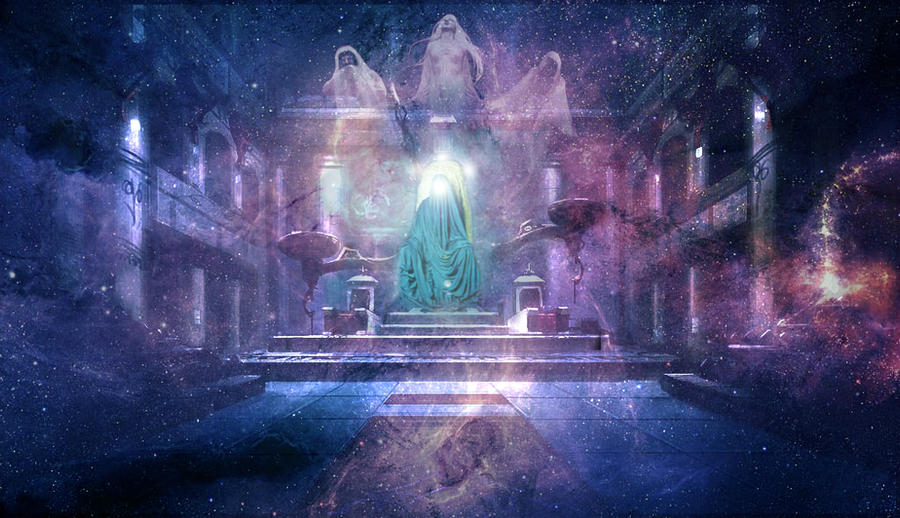
My discussion of Tolkien’s work is not without relevance, as there is also a “Chaos God” in Reincarnated As A Sword who develops “trials” of battle for life to maintain a balanced approach to stagnation and progression: “Finally, there was the God of Chaos, who threw the world into, well, chaos. But Garrus maintained that it was a necessary evil to keep balance in the world. Without chaos, stagnation would soon follow. The world needed to be kept on its toes to grow” [Volume 1, Chapter 4]. Here is one of the examples of “evil” under the context of the goal of life; evil by trait kills life, an inherent trait of life is to live, therefore killing is EVIL!!! But a necessary evil under the larger goal of progression, as suggested by the protagonist. Anyways, I found a fascinating play on “death” as the parameters for determining good and evil- or perhaps more clearly: if it’s in accordance with the rules of the game. These two quotes are from the Reverend Mother of the Bene Gesserit [Dune, Chapter “Dune”]:
“If you withdraw your hand from the box you die. This is the only rule. Keep your hand in the box and live. Withdraw it and die.”
“They tried and failed, all of them?” (Paul) “Oh, no.” She [Reverend Mother] shook her head. “They tried and died.”
Notice the substitution of failed with died in the second quote, but more interestingly the subtext of life and death as “the only rule”. This is a play on the fundamental distinctions of matter (although debatably not binary), where living matter strives for disequilibrium; to live. Taking a bit of a reductionistic approach to life’s goal, we are biologically designed with the goal to live. This was one of Bernard Suits’ [2] considerations of life’s “rule”, although it becomes further complex when observed goals as a multi-faceted construct with the framework of systems thinking. However, this demonstrates the establishment of clear parameters for the notion of good and evil, especially the idea of rules and failing as if it were a game. As suggested in my interpretation of Eru Illúvatar, a less moral-centric approach would be thinking about the dichotomy through the framework of goals, rather than a universality of good and evil. On the level of supreme Gods like Illúvatar, “good” is essentially whatever He wants.
This goal orientated perspective may align with defining evil as something against the plans of God, rather than particular traits that may end up ambiguous. It’s a sort related to a law concept with the whole actus reas (evil deeds) and mens rea (evil minds) for judging misdeeds and intent; basically, keeping the notion of evil complex (as goals are complex). Not a abstract absolute good or evil, but a set of rules that change with the dynamics of society. Dwelling on the virtue of protection and care, as Galadriel desired to use the One Ring for preservation of her Lothlórien realm, would be against the God of Chaos (if she were in the universe of Reincarnated As A Sword) despite being “good”. Perhaps it’s good in one way, but goals are influenced by a variety of factors. To simply place strict parameters on our collective goals would be a disservice to our complexities. Which is something we could consider when observing God’s ambiguous decisions. What He “wants” is a lot of things, he has plans for many things, it’s a disservice to understand Him so simply. But again, what can we do but try? If we lose sight of an important goal, then what then? Cue the Tengen Toppa Gurren Lagann music, because it discusses this as a “do we risk overexploting the universe for our hopes and dreams?” Consider it!
Note: Although, it really sounds like I’m quite a believer- I’m not. Perhaps you could consider me an agnostic, but don’t jump to conclusions regarding whatever that means for my ideas as an individual.
We try a lot of things to communicate our observations and ideologies. It’s inevitable that our limited perceptions would invite toxic rhetoric- we cannot escape it, only make better more versatile rhetoric. “I had once told Fran that the spirits could sense the presence of evil in a man. That was only half true. The ability was limited only to Mind Elementals” [Volume 2, Side Story: Klimt]. As we established that the framework for good and evil can be viewed through the framework of goals, this “sensing of evil” is an odd concept. How in the world could you sense such an abstract thing? There needs to be a new rhetoric that incorporates the multi-faceted realm of good and evil! And while I’m only limited to discussing volume 1-2, the dynamics of “evil” and what is consider as such are constantly considered. “Hatred and resentment are growing within me as well” [Volume 2, Chapter 6] was mentioned along with “the darkside” consuming one of the characters, which refers to a common association of evil with certain traits. Although Fran, a main character, is also fueled with the “dark” evil of vengeance- I mean she literally chopped a Blue Cat (humanoid race) into pieces while he was still conversing with her. She ultimately provides good to her community, but some of her actions can be extreme… How should we interpret this? Well, it’s up to the goals of her society and the intentions of the Gods.
Reliance on sense
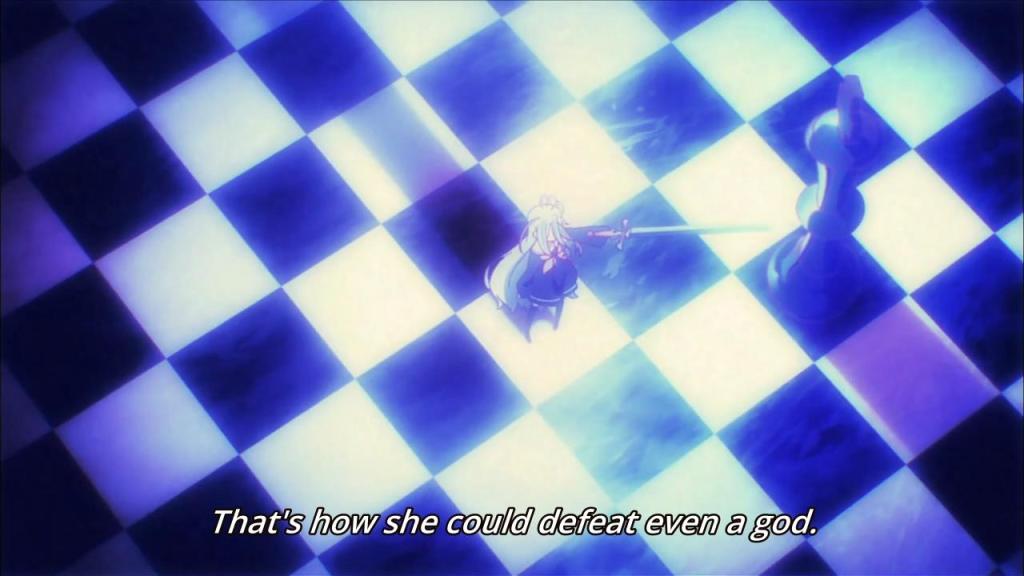
This discussion leads into my main point of inquiry: How do we make order in our world? The generic anime and stories that utilize previously established mechanics of video games can be seen as lazy, lame writing. However, it points to our comfortability with our complacency of order; a game design that makes sense. Inevitably, a sensible magic system or general familiar concepts lead to people flocking to party like it’s Friday night. Why Friday night? Well, because it’s the beginning of the weekend baby! It only makes sense to party on Friday! And when we have these establish parameters to adhere to, progress can be enhanced without conflicting ideologies (although conflict arises due to its nature of oppression- unless you can eradicate that oppression). I’ll briefly mention No Game No Life here (I’ll discuss further in the future), but the main characters Sora and Shiro are a representation of progress due to parameters. When there are clear goals established, typically by divine intervention (either by God or a game developer), they are comfortable and motivated; because things make sense: “There was no way to tell the goal, read the stats, or even identify the genre. Even if you followed the rules that were laid out, you’d be punished—and worst of all: those who just ignored the rules stood at the top—. Compared to this awful life, any other game was just too easy” [No Game No Life Volume 1, Prologue]. When your goals are laid out for you, it’s just too easy. And especially when those goals are the only thing that matters- they define reality. Not like organized education where external factors affect you, where you aren’t necessarily mentally or physically isolated to the other factors/parameters. In No Game No Life‘s isekai world, God created clear goals- although after they finish God’s game… now that’s going to invite a lot of conflict in how to traverse the rest of the universe. Disboard isn’t the only place in the universe in No Game No Life!
Note: If you’ve played God of War Ragnarök, you can see this struggle first hand with Odin himself: “See, mortals have it easy. When they push up against life’s big questions, they can look to us to give them meaning. Divine comfort. We both know that’s a sham. But when we have questions? Why are we here? To give meaning to mortals while living without it ourselves?” [God of War Ragnarök]. Read No Game No Life to see it tackle this question. The anime will need a season 3 to get to it…
Ambiguity can be forced into clarity based on popular rhetoric, as demonstrated with “evil” as a concept- which itself is a multi-faceted thing used by people’s cognitive metaphors to enforce a binary trait-based approach. You may receive a jumble of information from classifications and categories, but interpreting them according to your goals is another difficult situation. In Reincarnated As A Sword, a noble with a unique skill of detecting lies was suddenly stripped of his powers. Those easy “yes or no” prompts he often received were gone, and he inevitably failed to judge lies altogether- being very easily manipulated and fooled. Similarly, the Guildmaster Klimt discussed about how he approaches judgment through the utilization of magic: “I’ve relied on Identify [an obtained magical skill] and the spirits for so long that I’ve lost my eye for judging people. Nell, who befriended her on the day she came to us, knew more about her than I did” [Volume 1, Side Story]. Magic is itself a tool, a very reliable tool for specified goals. However, they don’t necessarily help with interpretation- that’s up to the individual. Perhaps the Gods can provide interpretation, but they themselves (at least in this narrative) are varied. Even if they provide a magic system with a variety of defined aspects, the wealth of perception can often lead to stagnation in reliance; interpreting what the tools see rather than the other aspects that flow through the world. Forcing a closed-system because it makes sense according to a set of morals and goals can develop into a limited interpretation and perceptive reach, a reductionistic approach, as suggested in another light novel I’m reading: “The Kingdom of Palettia had a long history of belief in our friendship with spirits. That was where the people’s belief system had been born— their faith that spirits were our neighbors and that we owed them our reverence. My ideas [that spirits had no consciousness to be “friends”] were heretical to such believers, so I seldom shared them with others. Because there were a great many people who believed, at one level or another, in the basic principles of spiritualism in this country” [The Magical Revolution of the Reincarnated Princess and the Genius Young Lady Volume 1, Chapter 3].
Ideology itself is a tool, as demonstrated in Shakespeare’s Titus Andronicus where Titus was led to kill his own children in the name of honour and pride for Rome. The narrative situates the adherence to ideology as an evil itself, painting Aaron (the villain) as morally righteous for being flexible enough with his ideologies (he’s the only one who protected his child)- although still evil for relying on the rhetoric of biology as a “only truth to ones’ self”, attempting to justify his deeds through relativism: we’re all different with different ideas and pleasures, that means we don’t need to take responsibility for our actions in the name of individualism! The dangers of such an ideology is outlined in how the external world functions itself, although a literature example would be The Picture of Dorian Gray if you’re interested. But it’s essentially an issue of balance, and this is a difficult concept to constantly consider as the center of gravity may shift due to various factors. Using this analogy, perhaps some manipulation of the scale whether deliberate or not can tilt it off the perceived center? How would one even attempt balance at all, or even know if there is a balance?
Constructing relationships with tools
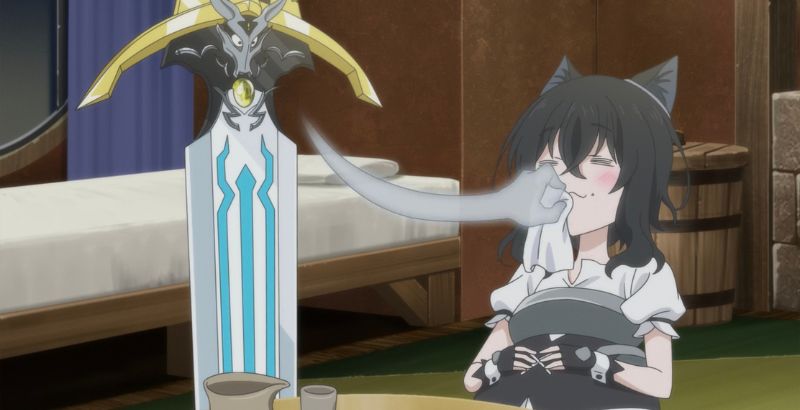
An interesting concept of Reincarnated As A Sword is that the protagonist was reincarnated… as a sword. He (or now they’re genderless as a sword?) has become a tool with the purpose of peace and war. Fran, Teacher’s (the protagonist) wielder, picked up Teacher as a tool for both defensive and offensive purposes. Purely viewing the sword as a tool, you can come to risk a limited approach to its range of influence- as demonstrated with both magic and ideology as a tool. It essentially risks viewing the world in a focused lens of using your lie detector skill to determine every “lie” or an identify skill to judge a complex individual. Perhaps considering a sword as complex individual is a stretch in our world, but Reincarnated As A Sword depicts a reality where spirits exist. If you’ve heard of the theory of panpsychism, it essentially suggests a similar notion that inanimate objects contain a level of consciousness. Side note: I read that Gregory L. Matloff tried to use this theory as an alternative to dark matter (ooohh spooky stars have consciousness!).
If spirits exist, they could manifest themselves into objects (or at least in this fictional world). Or perhaps it would be a “soul”? The narrative considers a lot of this in the Necromancer arc, with the concept of souls being present in every living individual, although they leave the deceased’s body. Necromancy would then be a result of creating a “pseudo-soul” with mana rather than directly interfering with a soul- which they cannot because the Gods restrict that practice. If Sauron the Necromancer lived in this universe, people wouldn’t really regard him unfavourably for necromancy!
Anyways, what’s with the relationship between Fran and Teacher? We’ve observed two characters in the narrative exhibiting over reliance on their magic, but what about these pair of main characters? In the spider dungeon arc, we were able to observe such a phenomenon that tested how much reliance played a role in Fran and Teacher’s relationship. Interestingly, Fran was able to survive despite not having Teacher to provide her with skills, magic, and a sword. She, even when she relied on Teacher, focused on developing her own skills and pushed herself to her limit when utilizing Teacher. Rather than letting Teacher perform all the difficult tasks for her, she relied on him as backup. Instead of thinking of the sword as a tool, Teacher was a friend/guardian who assisted her just enough to promote individual growth. That’s why naming has such a divine importance in the narrative as a form of relationship building, as we see with the two characters giving each other names, and later Jet (the wolf summon). But most importantly, this invited the variety of perspectives that comes with developing relationships and viewing people (or things) as individuals. This provides more than a closed-system of tools, but rather a tool that itself can provide more use than merely a defensive or offensive object (Teacher is literally a father to Fran, making her food, teaching her manners, etc). Often in many cultures, this spiritual relationship with objects is a subject of immense importance- and it’s particularly necessary in this reality, perhaps as the God’s test to prevent life taking advantage of others (or being too reliant on tools). A relationship provides an opportunity to expand and accept the open and chaotic system, a sort of holistic perspective that allows the idea of life to expand further than human superiority. This way, Fran and Teacher could still survive despite being separated- but they point is that they’re better together, but not reliant on being together for everything. Not objectifying each other!
Note: Fran was completely beginner-weak before meeting Teacher- but I’ll assume you have some context to the show while reading this. If you haven’t, then I hope you could string along! Ask me questions in the comments!
What’s the point?
From here, things make even less sense! If magic isn’t absolute, if tools are actually conscious, if Gods disagree, if order is an attempt at rationalizing reality- what does it make us? This is a fascinating topic to explore and I definitely won’t do it justice in this brief blog post (more in the future). However, I wanted to ramble about some thoughts on this perceived generic show to question how our frameworks tend to limit discussion on media. My personal belief is that art is communication itself- a fundamental aspect to anything perceptive and expressive (check out The Author of the Acacia Seeds. And Other Extracts from the Journal of the Association of Therolinguistics by Ursula K. Le Guin). We tend to communicate quite a lot in mundane expressions, whether it be a repetition of a genre’s tropes, or a “failed” attempt at something “new”. A lot of these things are viewed through narrative principles, often quite prescriptively utilized to limit discussion because “it’s not that deep”. This objectification of art is quite scary to me as I feel like we’re giving ourselves too much credit based on some ideology. Perhaps it could be like Aaron from Titus Andronicus who believed that his instinctual pleasures are the “truth”, and therefore there is no need for anything to influence his taste (similar to Lord Henry from The Picture of Dorian Gray). Or maybe we’d rely too much on film and literary principles to tell us what’s good? If even literary principles tell us that! As an English major, “good” is such a poor descriptive expression…
I recently watched a couple videos on the situation of YouTube content creation, where people follow a formula of GRABBING ATTENTION and having limited personality. Mr Beast commented on that latter point, suggesting that personality is subject to dislike- therefore a lack of personality would lead to a further reach, a wider audience. This itself is a principle for success, but is it necessarily “good”? Maybe in a descriptive perspective, it contains elements that our bodies react to- but not necessarily more than it may claim to be. “Good” is so full of rhetoric that principles generally work as a template for general hooks, but life is a complex system that can’t be boiled down to such approaches. Especially when it comes to individual tastes, it is a multi-faceted construct that I think we need to practice recognizing. That way, we can have things make a little more sense for all of us, not just the majority or any group. But merely relying on making content for a wider audience- that itself undermines the value of diverse art. If you attract a larger audience, the audience won’t have the liability to seek art themselves.
I think a good quote to end on: “In other words, what seems like common sense to one of us might be totally foreign to the other. You see? That’s why we need to share our ideas, to make sure we understand each other. We won’t be able to proceed otherwise” [The Magical Revolution of the Reincarnated Princess and the Genius Young Lady Volume 1, Chapter 3]. It might be a rhetoric that needs some work- “progression” is often a toxic mindset that places superiority on certain aspects of life. However, that’s why we need to discuss about these things no matter what we think is “deep” or not. We especially need to question how much we rely on “tools”, how much that is toxic to the complex external world, and what sorts of goals are we willing to stretch.
That’s been my ramble on the elements of fantasy and isekai. Obviously, I’ve left a great deal of things narrowly explored- zero organization… How can I mention Lord of The Rings without talking about the human-elf dynamic of stagnation vs progression?! If you’d like to discuss on any of these unexplored ideas, please leave a comment! And please share any papers, articles, or your own ideas!
Works Cited
[1] Situated Knowledges: The Science Question in Feminism and the Privilege of Partial Perspective
[2] Is Life a Game We Are Playing?
[3] Opinion | Is Life a Story or a Game?
[4] Oscar Wilde – Life Imitates Art
- I actually read snippets from “The Decay of Living” from the Broadview version of The Picture of Dorian Gray. It costs money, so read this article instead!
[5] “Two Musics about the Throne of Ilúvatar”: Gnostic and Manichaean Dualism in The Silmarillion
[6] Good and Evil in J.R.R. Tolkien’s Legendarium: Concerning Dichotomy between Visible and Invisible


Leave a comment