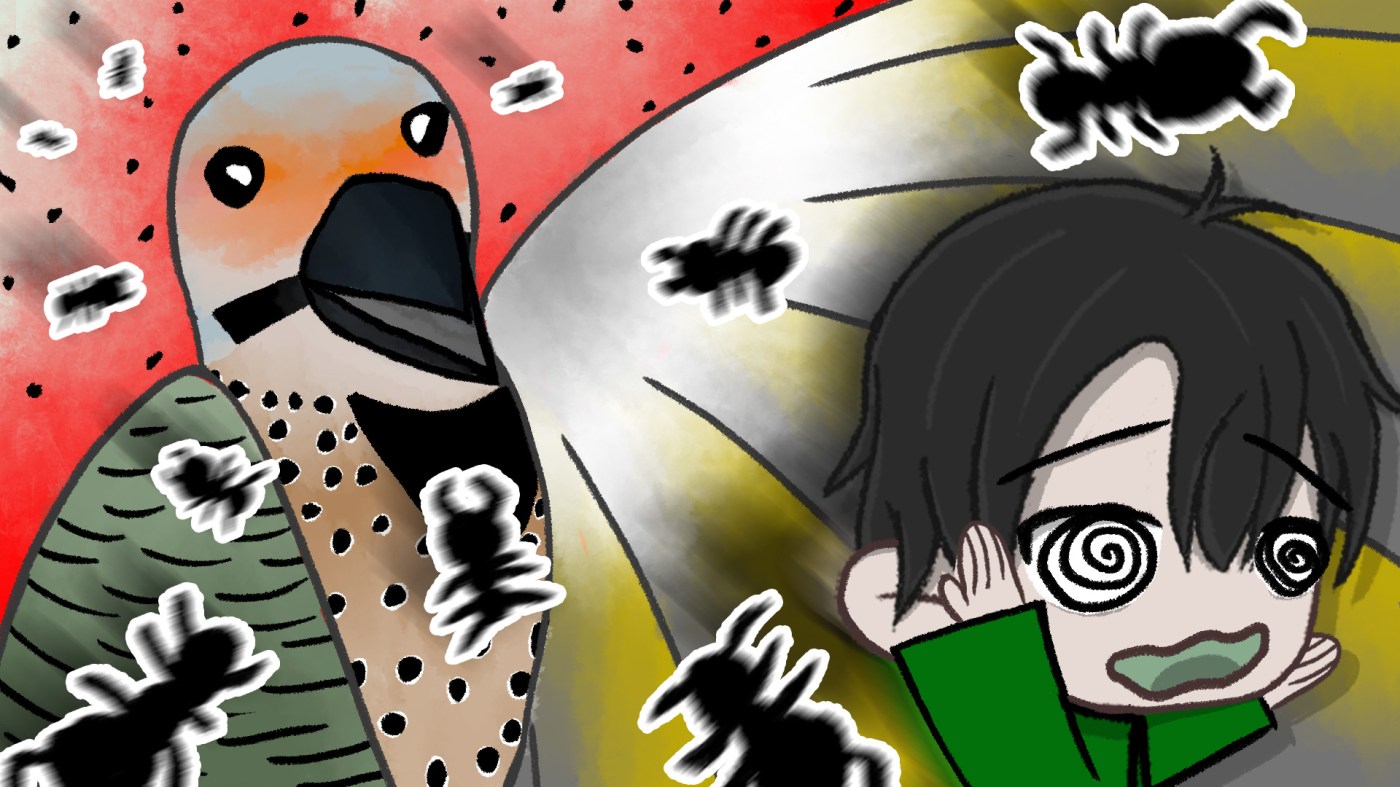
A very elaborate and stubborn video (link: https://youtu.be/ulI6MWxF_f4), forced to completion to avoid a constant repeat, but it’s finally done…
There are a lot of things I’d like to change, but just like with any single video – there’s always next time! Next time I’ll make it shorter, next time I won’t accidentally edit the video in 1000×600 aspect ratio, next time I’ll be mindful of how elaborate the script is, next time I’ll make sure to pronounce things as they’re meant to and check my grammar LOL, next time I’ll include less quotes in the video (too much reading), next time I won’t rush because I’m tired of the video… and so on.
With that in mind, please let me know what you think! I’ll be focusing on making shorter videos with much more experimentation from here on out!
Full script (with comments)
Learning has been one of the toughest things for me. I hear many things, but I’m never sure how to process them. They show up in many of the quizzes and exams I encounter: things like the years of historical events, the names of plants, the elements on a periodic table and… you know, like… facts!
Tell me, can you name 100 countries? If you can’t, then… bruh. What did they teach you in school? I’ll tell you right here that this is the eurythenes plasticus [I didn’t mention this in the video, but this species can be found here: Weston, J. N. J., Carrillo-Barragan, P., Linley, T. D., Reid, W. D. K., & Jamieson, A. J. (2020). New species of eurythenes from hadal depths of the mariana trench, pacific ocean (crustacea: Amphipoda). Zootaxa, 4748(1), zootaxa.4748.1.9. https://doi.org/10.11646/zootaxa.4748.1.9]. And no, I barely know anything about it. But that’s fine, right? The point is to know about things – categorize them accordingly to build a sense of entanglement with the world. There’s nothing wrong with simply knowing facts, as in what we believe we would know from something. If it’s an animal, then: name, diet, lifespan, behaviour, and all that which exists in our abstract categories. Efficiency is the name of the game – we can’t just learn everything in wildly new ways.
I think this is the appeal of online quizzes. We’ve all done them: Things like testing your personality type, anime expertise, whether you know the types of fish and… there’s a million things you can quiz yourself on, and a million people making the quizzes. To be appealing is often to rely on categories that people can recognize.
Two quizzes I’ve been playing around with are Birding Quiz [36] and eBird [37], which test you on your visual and audio identification skills. And these seem like one of the more popular types of quizzes; because, well, the goal is to identify things – identify them based on features we’re familiar with like: colours, shapes, and sizes. But… it sort of turned into a 1-dimensional game at some point, like: I remember just learning about countries through their flags and locations on Earth, the goal was just to get the most correct within a set time-limit. But that was the extent of most of my learning – to just “know” that they existed for the sake of a better score. Even with these birding quizzes, I don’t think I learned much other than what I already knew. I could see a bird and tell you what their names were, but yeah – that’s it. And that led to the hard part about learning; when things don’t always fit my categories – when there are 2 woodpeckers [hairy and downy] that look almost the same, crows [american and northwestern – which are apparently a merged species? Not sure, maybe I’ll make a video on it?] that are also so difficult to differentiate, and other things that I’d never even think about.
To address this troubling realization that the world isn’t as simple as I’d like it to be… I did what any typical person would do: Google, beep boop, top results. Yeah, it’s very easy to do hard things these days! Anyways… There were a lot of birds I wanted to learn more about: wood ducks, varied thrushes, black-capped chickadees, song sparrows, double-crested cormorants, american robins… However, the northern flicker caught my eye. Mostly… because, well, they were the easiest to identify in the quizzes.
American Bird Conservancy
So, the first website I saw was by the American Bird Conservancy [1]. It had this cool map
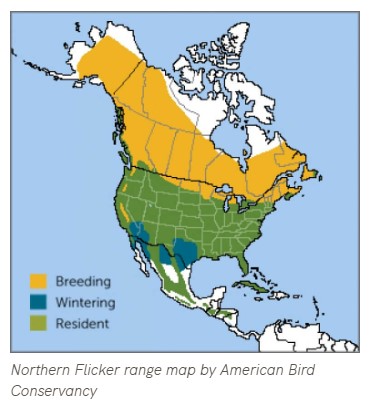
and lots of information. Some notable facts I gathered were for their nesting behaviour: Which mentioned that because of their weak bills, they often take over existing woodpecker holes or excavate in soft wood of a dead, decaying tree [“Because their bills are not as strong as those of other woodpeckers, Northern Flickers will often take over an existing woodpecker hole and enlarge it as needed, although they sometimes excavate their own new home in soft wood of a dead, decaying tree or branch.”].
And it’s interesting that they mention this because… well, I didn’t even realize they were woodpeckers, and woodpeckers with weak bills too??? Is there a scale to how strong or weak a woodpecker’s bill are [is bruh]? And I mean, woodpeckers usually have “woodpecker” in their names, right? Pileated woodpecker, downy woodpecker, hairy woodpecker… Okay whatever, ignorance aside, there were other details such as:
- They dine on insects and their larvae, [“This woodpecker also dines on other insects and their larvae,“]
- As well as fruit, and blah blah blah [“as well as fruit, especially wild cherries, wild grapes, and dogwood, sumac, and poison ivy berries.”]
- They do a “wick wick wick” sound [“The Northern Flicker’s song is a loud, even-pitched “wick wick wick wick wick.””]
- During winter, they have… whatever, more fruits and berries. [“During the winter, more than half of its diet is comprised of wild fruits and nuts.”]
Like a bunch of quick and easy facts and stuff. But… one particular fact I found fascinating was that:
- One flicker’s stomach was found to contain more than 5,000 ants! [“Ants make up much of its diet during the nesting season: One flicker’s stomach was found to contain more than 5,000 ants!”]
What?? 5,000!? How did people figure this out? And there were no sources. The few embedded links just cited back to their own website when referencing other birds like the downy woodpecker, common grackle, and their other birds and information.
And so… initially, I wasn’t skeptical about these facts, but seeing the “5,000” floating around without a clear way to trace it… like this isn’t a common observation that doesn’t need a citation. I mean… “5,000 ants” is surprising, like it was some sort of throw-away-line meant to entice the reader. And yeah, I’m definitely enticed. But I wanted more – a direct source to this number. And this was when I thought: What if I spend some time to learn about things beyond their initial appearance??
So, it was time to go on a little online adventure! My goal: find out where this “5,000” ants came from. To start, I decided to look at general info-articles and blogs.
The Search: Part 1 – General Info-Pages
And to my genuine surprise… on every website I found during this initial hunt, sites like Cornell Labs [2], National Geographic [3], Birdweb [4], Birdfact [5] – every page I saw mentioned nothing of the 5,000 ants. Like, what? Why? Where in the world did this number even come from? From these websites, the only mentions of ants were general statements such as:
| Cornell Labs [2] | “flickers eat mainly ants and beetles“ |
| Audubon [6] | “Mostly ants and other insects. Probably eats ants more frequently than any other North American bird.” |
| Animalia [7] | “They feed mainly on ants but also insects“ |
| Birdweb [4] | “principally on ants but also take other insects and some fruit” |
| Birdfact [5] | “although ants are their favorite food“ |
| National Geographic [3] | Nothing. Nothing about ants. |
And, oddly enough, National Geographic had nothing on ants.
Anyways, even within this small count of 6 websites, I noticed an odd inconsistency among certain topics. Like almost every website said that they nest in tree cavities, but Audubon [6] says they “burrow in the ground”, although they said that northern flickers rarely do that, Audubon still mentioned it [“Nest site is cavity in tree or post, rarely in a burrow in the ground”]. The only other account of this was from Birdfact [5], which said they “burrow in an earth bank” [“usually in a dead tree, but sometimes in a cactus, a burrow in an earth bank, or a big enough nest box”]– then later says in another article [8] that they “occasionally nests in burrows abandoned by other bird species.” So, they obviously got this from somewhere, but WHERE? And why had these 2 websites alone mentioned it? Isn’t this fact interesting?
Nesting Variation
And it wasn’t just that – the most interesting variations between these websites were actually the nesting facts. The first website I encountered was Cornell Labs [2]. They established the quantities which I’ll use as the base numbers for comparison:
So: They said that the incubation period lasts 11 to 13 days, nest placement 6-15 feet from the ground, 1 brood per breeding season, and clutch size of 5-8.
| Incubation Period | Nest Placement | Broods | Egg Count (Clutch Size) | |
| Cornell Labs [2] | 11-13 days | 6-15 feet from ground | 1 | 5-8 |
Then clicked on Audubon’s [6] page, which had even larger numbers:
| Incubation Period | Nest Placement | Broods | Egg Count (Clutch Size) | |
| Cornell Labs [2] | 11-13 days | 6-15 feet from ground | 1 | 5-8 |
| Audubon [6] | 11-16 days | 6-20 feet | 1 a year, 2 in the South | 5-8 |
Next, the website Animalia had some more variation… But oh my god, I did not expect this at all: They even did an almost word-by-word copy of Cornell Lab’s [2] diet description:
- “Flickers also eat berries and seeds, especially in winter, including poison oak and ivy, dogwood, sumac, wild cherry and grape, bayberries, hackberries, and elderberries, and sunflower and thistle seeds” [2].
- “Flickers also eat berries, seeds, and nuts especially in winter, including poison oak and poison ivy, dogwood, sumac, wild cherry, grape, bayberries, hackberries, and elderberries, as well as sunflower and thistle seeds” [7].
It’s probably not big of a deal, but it’s funny.
| Incubation Period | Nest Placement | Broods | Egg Count (Clutch Size) | |
| Cornell Labs [2] | 11-13 days | 6-15 feet from ground | 1 | 5-8 |
| Audubon [6] | 11-16 days | 6-20 feet | 1 a year, 2 in the South | 5-8 |
| Animalia [7] | 11-12 days | 2 broods per second | 6-8 |
Then looking through Birdweb [4], they didn’t really contribute much to the variation.
| Incubation Period | Nest Placement | Broods | Egg Count (Clutch Size) | |
| Cornell Labs [2] | 11-13 days | 6-15 feet from ground | 1 | 5-8 |
| Audubon [6] | 11-16 days | 6-20 feet | 1 a year, 2 in the South | 5-8 |
| Animalia [7] | 11-12 days | 2 broods per second | 6-8 | |
| Birdweb [4] | 11 days | 5-8 |
And finally Birdfact [5] showcased a relatively shorter incubation period.
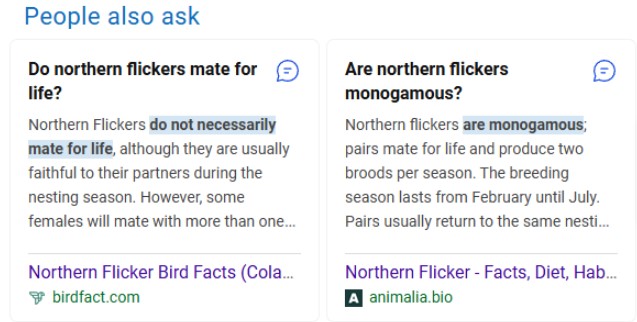
But aside from nesting, they said that northern flickers don’t mate for life [“Northern Flickers do not necessarily mate for life, although they are usually faithful to their partners during the nesting season. However, some females will mate with more than one male.”]? But… Animalia [7] says they do [“Northern flickers are monogamous; pairs mate for life and produce two broods per season”]!
Like, where did this variation even come from? It sounds like a big confusion – a confusion that is that immediately confronted to any non-bird expert when they look this up – and this is literally just a screen shot from the front page of Google:
Also, two articles from Birdfact provided different numbers for clutch size… for some reason [Birdfact [5] gave 6-8, while Birdfact Nesting [8] provided 5-8…].
| Incubation Period | Nest Placement | Broods | Egg Count (Clutch Size) | |
| Cornell Labs [2] | 11-13 days | 6-15 feet from ground | 1 | 5-8 |
| Audubon [6] | 11-16 days | 6-20 feet | 1 a year, 2 in the South | 5-8 |
| Animalia [7] | 11-12 days | 2 broods per second | 6-8 | |
| Birdweb [4] | 11 days | 5-8 | ||
| Birdfact [5] | Normally 1 | 6-8 | ||
| Birdfact Nesting [8] | 9-10 days | 5-8 |
Anyways, overall there was a consensus around 11 days for the incubation period, while Birdfact [8] kinda went for a relatively lower number. Nest placement was higher for Audubon [6]. A lot of variation in brood production. And clutch size had 2 imposters [Animalia [7] and Birdfact [5]].
It’s really difficult to make out what to think. At this point, I don’t really care much about who’s correct, but more about where the information came from. Why is there even variation in the first place? Why didn’t they cite their sources or leave any paper trails to certain information?
A Real Study
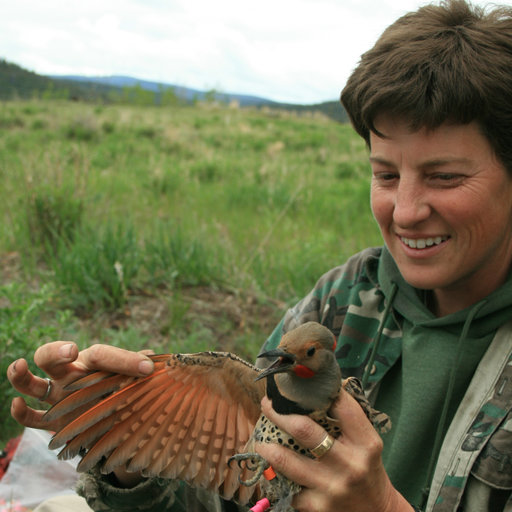
So, to establish a reference point, I found an actual study. And it had quite the statement that it is: The largest study to date dedicated to understanding the reproductive blah blah blah… [“The largest study to date dedicated to understanding the reproductive ecology, life history, and population ecology of the Northern Flicker is a long-term study at Riske Creek in central British Columbia, where Karen L. Wiebe monitored 100–175 color-banded nesting pairs annually from 1997–2014” [9]]. Like… it sounded sophisticated enough for me to use it as a reference point. I mean, one of the authors seems to absolutely love northern flickers:
So, to address the variation in incubation period, the study observed 11.9 days as the average [“the average time for embryo development (onset of incubation on that egg to the hatching of that egg) was 11.9 d (range 11.2–12.4)”].
There was a lot of variation on the average nest cavity heights. Which makes sense for the variation between Cornell Labs [2] and Audubon [6], I guess? Probably depends on what reference each website used:
| Wisconsin | 5.7 m |
| Ontario | 7.0 m |
| Iowa | 8.1 m |
| Wyoming | 7.3 m |
| Nantucket Island, Massachusetts, where trees are scrubbier | 1.3 m |
| Greater heights in tall Douglas-fir (Pseudotsuga menziesii) in western Oregon | 11.4 m |
For the number of broods per season… apparently there are no confirmed records of second broods, especially due to the study’s methods inhibiting this. The study suggests that its possible, but I don’t know [“There are no confirmed records of second broods and this would be hard to determine without color-banded individuals.”].
The interesting thing was that Animalia [7] said how northern flickers had “2 broods in the south”??? Did they confuse the Northern Flicker with a different species? Or is the south more susceptible to their first clutch being destroyed [“However, the relatively long breeding cycle of the Northern Flicker means that only one brood can probably be raised in most of the geographic range (213), but a pair may renest if their first clutch is destroyed.”]? Well, I have no idea… but moving on…
The clutch size had some variation. Although the websites mostly stuck to a safe 5-8 number.
| United States | 6.5 ± 1.4 SD |
| British Columbia | First try: 7.99 ± 1.3 SD Second replacement: 6.83 ± 1.1 SD All clutches pooled: 7.81 ± 1.4 SD |
| Washington State | 7.0 |
| Sutherland, Nebraska | 7.50 ± 1.53 SD |
| Bridgeport, Nebraska | 7.16 ± 1.37 SD |
| Morrill, Nebraska | 6.97 ± 1.28 SD |
| Wheatland, Wyoming | 7.75 ± 1.48 SD |
And there were other things like Audubon’s [6] and Birdfact’s [5] account of northern flickers nesting in burrows. This study also addressed it, saying that northern flickers rarely may nest in earthen burrows [I pronounced it as “barrels” in the video LOL], and there were a handful of reports of northern flickers nesting directly on the ground, but no such nest has been successful [“Rarely may nest in earthen burrows; e.g., used nest burrows of Belted Kingfisher (Megaceryle alcyon) or Bank Swallow (Riparia riparia) (222). There are a handful of reports of Northern Flickers nesting directly on the ground, a review of cases is in (223), but no such nest has been successful.”].
It’s an interesting occurrence, I definitely understand why Audubon [6] and Birdfact [5] mentioned it. But there’s so much nuance to it: The paper discusses how northern flickers do this in areas lacking suitable trees [“In areas lacking trees, Northern Flickers have been reported excavating cavities into vertical earthen banks within deep-cut riverine systems, steep canyon walls and/or relief-cuts for transportation routes” [41]], in areas of high competition [“Competition with European Starlings (Sturnus vulgaris) for nest sites has been described…a complete lack of alternative tree substrates may lead to ground nesting” [41]], only one observation saw successful hatching [“Eggs hatched in only one of the nests, but the fate of the hatchlings was unknown” [41]], and it is generally unclear why they do it [“Studies suggest reproductive success is higher for Northern Flickers that nest in tree or pole cavities (Dennis 1969, Wiebe 2003, Fisher and Wiebe 2006b), thus it is unclear why sometimes presumably suboptimal sites are chosen” [41]].
The ultimate question is: Why didn’t they say much about these nuances? Why didn’t these websites just cite these reports? Unless they saw it happen themselves? Maybe they just saw Google images of northern flickers in a cactus [Birdfact said: “usually in a dead tree, but sometimes in a cactus, a burrow in an earth bank, or a big enough nest box” [5], with no source, so I assumed it was just something they either saw in-person or through online images]?
But to settle the dispute between Animalia [7] and Birdfact [5] regarding mating for life, the paper [9] indicates that they actually aren’t monogamous according to this quote: [“Polyandrous females contributed less incubation at their secondary nest than a monogamous female because they were simultaneously feeding nestlings at their primary brood (188).”]
Which discusses the differences between polyandrous and monogamous female northern flickers. However, it may depend on the wording, since the study on northern flickers nesting on the ground [41] we just looked at actually mentioned that these birds are “usually monogamous” – which is a bit different from totally monogamous [“are monogamous” [7]].
Once again, I don’t know where either website got their information.
Anyways, the websites’ words against Karen L. Wiebe and William S. Moore’s – and after doing all this digging around, I realized that I forgot my original goal: what about the 5,000 ants??? Oh my… what am I doing?
Any ants in Wiebe and Moore’s study?
So I continued looking through this study by Wiebe and Moore [9] and they said that they found that: ants usually comprise the majority of the diet of the northern flicker [“ants (Hymenoptera: Formicidae) usually comprise the majority of the diet [of Northern Flickers]”]. No real number, but yeah… there were also percentages [“Based on hard chitinous fragments in fecal samples of breeding adults at Riske Creek, British Columbia, about 98% of the diet (based on frequency of items) were ants of several genera (164). Animal matter, mainly ants, termites and beetles, formed 98% of the volume in the stomachs of 19 adults from Grand Cayman Island (158). DNA barcoding of fecal samples of 24 nestlings from 6 nests from a recently burned forests in western United States revealed greater diet breadth with 83% of the fecal samples containing ants and with Diptera, Lepidoptera, and Hemiptera also being common, found in 60–83% of samples (166).”], however, nothing on 5,000 ants, or at least they didn’t specifically mention it. Back to square one – the only source that mentioned the 5,000 ants was the original website; the American Bird Conservancy [1].
The Search: Part 2 – Specifically 5000
So, I decided to search for the 5,000 ants through articles and websites that did specifically mention it.
The first source other than the American Bird Conservancy [1] was Nature News (Seacoastonline) [10] which said this: [“According to the American Bird Conservancy, one flicker’s stomach was found to contain more than 5,000 ants!”]
Finally, a website that mentioned it! Oh my god… But even though they referred to the American Bird Conservancy [1], which, well, I’ll assume they got most of their information from, they said that their beaks are big and powerful like most woodpeckers [“Their beaks are big and powerful like most woodpeckers, but have a slight downward curve, more useful for digging in the ground.”].
But wait, didn’t the American Bird Conservancy [1], one of their sources, say that their bills are not as strong as other woodpeckers [Here is the American Bird Conservancy’s quote: “Because their bills are not as strong as those of other woodpeckers” [1]]?
So if I’m interpreting this right, it seems like Nature News [10] must have disagreed with how the American Bird Conservancy [1] presented the northern flicker’s bill, and instead got information from somewhere else… but where??? No other citations, not even for the 5,000 ants… 13:38
Anyways, I kept looking and found another reference to the 5,000 number from Bird Watcher’s General Store [11]: [“One flicker was found with over 5,000 ants in its stomach, plus cole slaw and a pickle.”]
But they also didn’t cite where the number 5,000 came from! They even said that northern flickers haven’t developed the same carpentry skills that the other tree-bound woodpeckers… WHAT??? [“Probably because flickers have opted for eating soft ants on the ground, they [Northern Flickers] haven’t developed the same carpentry skills that the other tree-bound woodpeckers have.”]
Weak bills?
Just like what the American Bird Conservancy [1] said, the northern flicker’s bill, once again, is weak or not “skilled”, or like not “woodpecker” enough. So, I wanted to consult the previous study by Wiebe and Moore [9]. And looking through the study, I couldn’t really find an account of their “weak and not so skilled” bills, but I guess this is somewhat related. The study said that northern flickers tend to use existing nest cavities more frequently than most other woodpeckers [“Northern Flicker tends to use existing nest cavities more frequently than most other woodpeckers but reuse is quite variable among populations (230).”].
And the paper that was cited showed somewhere between 5 to 65% reuse rate [22], but it also identified interesting categories of excavators: strong and weak… The former having the ability to penetrate hard wood, while the latter are unable to [“Strong excavators with reinforced skulls, ribs, and chisel-like bills can penetrate into hard sapwood and extract a concentrated food source, beetle larvae, from beneath the bark during winter (Connor 1981; Korol 1985). Weaker excavators, unable to penetrate thick bark and hard wood, efficiently exploit seasonally abundant prey on the ground, in bark crevices, or on leaf and bark surfaces but must broaden feeding niches in winter (Connor 1981) or migrate.” [22]].
Which one is the northern flicker? Strong or weak excavators? Looking further in another paper [23], I found that northern flickers were considered part of the primary excavators; “the most abundant excavator”, as well as part of the secondary cavity nesters [“but they also reused nest sites and, as secondary cavity nesters”], those who acquire nests from other species, but they weren’t categorized as weak excavators like the black-capped chickadee or downy woodpecker.
| Primary Excavators | Secondary Cavity Nesters | Weak Excavators |
| – Black-backed Woodpecker – Three-toed Woodpecker – Pileated Woodpecker – Hairy Woodpecker – Red-naped sapsucker – Northern Flicker | – Bushy-tailed woodrat – Deer mouse – Short-tailed weasel – Red squirrel – Northern flying squirrel – Mountain Chickadee – Tree Swallow – Mountain Bluebird – European Starling – Northern Saw-whet Owl – American Kestrel – Bufflehead – Barrow’s Goldeneye – Northern Flicker [They weren’t listed in this table, but were mentioned to be secondary cavity nesters in a quote within the paper: “but they also reused nest sites and, as secondary cavity nesters”] | – Black-capped Chickadee – Downy Woodpecker – Red-breasted Nuthatch |
Basically, they definitely seem to live up to the “woodpecker” name [“Northern Flickers are abundant woodpeckers that create large holes, and thus are likely responsible for the diverse and abundant array of secondary cavity-nesting vertebrates.”], and these studies [22][23] described a lot more information than just categorizing them as “strong” or “weak”, or even “unskilled”.
But… like okay, this isn’t even what I’m trying to figure out. You can look into this yourself but… Anyways the point is, there were also no citations for the 5,000 ants in Bird Watcher’s General Store’s website [11]. So I had to keep looking…
Back to ->The Search: Part 2 – Specifically 5000
I found this website called The Last Green Valley [12] where the author said: “I did a bit more reading about flickers and found they eat more ants than any other North American bird. In fact, a biologist once found the remains of up to 5,000 ants in the stomach of a flicker.” Okay… so they did more “reading”, but what reading?
Just tell us where you did the research BRUHH! Where did you get this from? Okay, maybe it’s a bit tough to do when some people are writing a blog everyday or making a last minute TikTok video, I get the stress of having to do citations. I still can’t do it properly after 4 years of university. It’s annoying to track how your information is gathered. But still – it’s really frustrating when I’m trying to do the same research as they do, but they don’t provide their methods. And I’m sure they have a document somewhere with all their sources, like over here: you can find all my citations and notes in the description.
However, they did cite Cornell Lab of Ornithology [2], which was one of the info-pages I looked at previously. Though, this source never mentioned anything about 5,000 ants. So… where did they hear about the 5,000 ants if it wasn’t Cornell Labs [2]? I don’t know…
Anyways, I didn’t get any information there, so I went on to NatureMapping [13], which also mentioned the number: [“Ants are their most important source of food. One flicker’s stomach was found to contain more than 5000 ants.”] Once again, no source for this number!
I also felt like I was having deja vu while reading this article. Like… they repeated almost the same line in the same blog:
- First quote in the article: “It has a cylindrical worm-like tongue, with a hard sharp tip that can be extended far beyond the end of the bill to spear an insect in a hole. The body of the tongue is covered with sticky saliva to capture ants and other small insects.”
- Second quote in the article: “It has worm-like tongue, with a hard sharp tip that can be extended far beyond the end of the bill to spear an insect in a hole. The body of the tongue is covered with sticky spit to capture ants and other small insects.”
Kinda funny, I’m not sure how that happened.
But they actually have sources, from Birdweb [4] (which we already looked at) and the WDFW [14], which has a broken link [this is the original link (doesn’t work): http://wdfw.wa.gov/wlm/living/northernflickers.htm]… but no actually, I used the search function and I found the page! They said “Leave ant colonies for flickers to find and harvest. (An Oregon biologist found over 2,000 ants in the stomachs of flickers.) [14].” What? The number mysteriously halved! Ahhh, goddammit – back to looking for the 5,000 ants!
And actually, I’m just going to speedrun through this because this video is taking too long… let’s go: The chesapeakebay [15], I think that’s (how you pronounce it), I don’t know… said “They have been recorded eating as many as 5,000 ants in one sitting.” No sources. Bird Friendly Calgary [16] says “Flickers are prolific anteaters consuming up to 5000 a day during the summer! With this, they…” blah blah blah. No sources. The Atlanta Journal-Constitution [17] says “Biologists have found as” bleh bleh “5,000 ants in a flicker’s stomach.” No sources.
And Wild About Ants [18] was the most promising so far: Giving citations for 2,600 ants consumed by a rufous woodpecker, and mentioning the 5,000 ants of the northern flicker. [“Vishnudas (2008) cites an earlier worker from 1912 who found 2,600 ants in the stomach of a rufous woodpecker.” and “Northern flickers probably eat the most ants. They spend much of their time feeding on the ground around anthills. One flicker was found to have 5,000 ants in its stomach.”] But they only gave citations for the rufous woodpecker! Not for northern flickers! Like… WHY??? It’s like they’re intentionally avoiding citing the number! And also… apparently this website got suspended… Bruh [So… I didn’t archive the website. I’m sure I quoted them accurately, but since there’s no way to confirm it… I guess you could take my word for it or ignore this part!].
But anyways, let’s keep going: Wild South Florida [19] says “A study done in the 1930s found that one northern flicker” blah blah blah “5,000 ants.” Wait… Isn’t this a lead! This number was from the 1930s (according to this website)! But, what the heck! They didn’t cite it! How do I even find this study? 1930s? Is that all they’re giving me? And the FWC link they reference doesn’t even work [original link they used: http://legacy.myfwc.com/bba/docs/bba_NOFL.pdf]… Though, I actually looked it up myself and found the actual page [24] which… also didn’t say anything. And the citation to Howell 1932 [which [24] cited as the original source to the 5000 number]… I couldn’t find it!
The only few things I found in the 1930s was this newspaper article about a guy named Chickadee who saw birds [25]. And a couple of papers [26][27] that didn’t mention any large 5,000 number. Whatever, moving on!
I found a radio show thing, Laura Erickson’s For the Birds [20], which recited the same thing: “One ornithologist counted over 5,000 ants” blah blah blah. No source.
FOUND IT
But then I found it… oh my god, I found it!
From BirdsByBend [21]: [“Professor Beal (1911) has shown that 60.92 percent of its food consists of animal matter and 39.08 percent of vegetable matter…The flicker eats more ants than any other bird; ants were found in 524 of the 684 stomachs examined, and 98 stomachs contained no other food; one stomach contained over 5,000 ants, and two others held over 3,000 each.”] And with this specific reference to Professor Beal in 1911, I searched through the scientific literature and found it…
“Foods of the Woodpeckers of the United States”, by F. E. L. Beal in 1911, Biological Survey Bulletin No. 37, Page 52-54 [35]… I assume, and I’m just going to assume… that this was the original source of the 5,000 number: Professor Beal found a mass of animal matter in a northern flicker, separated it into 16 parts, each counting to 315 ants. 16 x 315 is 5040 ants. There ya go, this is probably where the 5,000 number came from.
And out of sources that referenced the number, only this website had directly referenced where the number came from.
No that’s not true… Apparently Wiebe and Moore [9] also cited Beal (1911) [35] [this is one of the quotes where Wiebe and Moore cited Beal (1911): “Beal (163) provided a detailed quantitative analysis based on stomach contents which is summarized in Table 4. Unfortunately, Beal did not state whether percentages of stomach contents represent biomass or counts of individual prey items nor did he give a complete breakdown of collecting locales and dates.”], but actually… I only realized after doing all this research. I didn’t notice it because they didn’t mention 5,000 ants despite having the study in their citations. Which is… weird. Is there something wrong with this number?
Phrasing of facts
| “According to the American Bird Conservancy, one flicker’s stomach was found to contain more than 5,000 ants!” [10] |
| “One flicker was found with over 5,000 ants in its stomach” [11] |
| In fact, a biologist once found the remains of up to 5,000 ants in the stomach of a flicker.” [12] |
| “One flicker’s stomach was found to contain more than 5000 ants.” [13] |
| “They have been recorded eating as many as 5,000 ants in one sitting.” [15] |
| “Flickers are prolific anteaters consuming up to 5000 a day during the summer! With this, they help control ant populations.” [16] |
| “Biologists have found as many as 5,000 ants in a flicker’s stomach.” [17] |
| “One flicker was found to have 5,000 ants in its stomach.” [18] |
| “A study done in the 1930s found that one northern flicker had eaten nearly 5,000 ants in one sitting.” [19] |
| “One ornithologist counted over 5,000 ants in the stomach of a single flicker.” [20] |
Like, okay look at the way websites phrase this 5,000 ants fact. It’s like some sort of buzz-phase. They’re all generally written the same way, with barely any variation. The major variation comes in how they contextualize the number, such as attributing it to a biologist [17], an ornithologist [20], and even using it to suggest their role in supposedly controlling ant populations [16].
But another variation comes in the number itself. It’s either “more than/over” [10][11][13][20] or “up to/as many as/nearly” [12][15][16][17][19]. Some also are strangely more detailed, saying things like “during the summer” [16], “in one sitting” [19], or “a study done in the 1930s” [19].
Omission and inclusion
Did each website just try to add a random spin to the number? Did they hear about this number from different sources? And why did they decide to omit their source to the number – they heard it from somewhere, right? Actually, one of the websites, Wild South Florida [19], which used a source by FWC [24], seemed to have the right information about the nature of the 5000 ants number [“In one study, ants were found in 524 of 684 stomachs examined, and 98 stomachs contained no other food (Howell 1932). One bird had consumed almost 5,000 ants.” – This quote from FWC aligns with Beal’s (1911) work, all the numbers are accurate.], but they cited Howell 1932 – which I cannot find, nor the “The atlas of the breeding birds of Florida. Final Report” [which was what the FWC link cited for their information].
I assume for most websites, it’s because they just saw “5,000” on another website, such as the American Bird Conservancy [1], rather than the primary source [35] – and the lack of nuances from these secondary sources made it spiral into a sort of “cliche” fun fact to entice the reader.
But why didn’t some of the websites use this number? And again… it’s weird that the study by Wiebe and Moore [9], which actually had the source to the number from Beal’s 1911 study, decided to omit the number entirely. Is this number just irrelevant? Unreliable?
Interestingly, some studies and newsletter sources I read seemed to value the percentage and frequency aspect more than the actual individual volume of ants; none of them ever used the “5,000 ants” number [28][9][42][43][44][45][46][47][48][49]. Maybe because percentages and frequency are more usable and research-relevant than some number that can only really be attributed to one northern flicker?
Although on the other hand, it seems that the websites that happily referenced the number found the number much more useful. I mean, their goal is to make the northern flicker attractive and interesting to a typical person. Saying things like “5,000 ants”, “weak bills”, “monogamous species” – it’s less complicated. Their audience might be satisfied with just that. So, maybe it’s not really a problem for a lot of people? It’s not really a big deal as they aren’t the ones dealing with urgent issues like conservation and research.
Trying to rationalize this…
Facts may be a sort of simplification of research; something people can eat up, generalize, and intuitively follow like a law. But it’s probably okay? We don’t always have all the time in the world to research these things. Experts don’t always have all the time in the world to meticulously teach them either. It might be alright to only know the answers to some online quizzes and nothing else? Because it’s efficient and useful that way for most people.
For many people, knowing the baseline is efficient enough to be satisfactory. Because, let’s be honest here – the lengths I had to go through in order to get information on 5000 ants… it’s annoying. Most websites get information right anyways. To bother with researching the original source… it isn’t always a comfortable situation. I don’t need to know the difference between weak and strong woodpeckers, nor whether the northern flicker is monogamous. Who cares about the incubation period and whether each website is correct? Who cares who said what? It doesn’t always concern me.
Keeping this in mind, well… Is any of this useful to me? Is it efficient for me? Why is learning so tough? Because people expect us to know so many random things? What do I personally want? And do I really care as much as I’d like to? It’s a heavy topic, I don’t know what else to say… and I actually planned to answer it all these questions in this one video – rush out things for a quick satisfaction.
But seeing as there are a lot of dimensions to the process of learning, so many things to think about. I should probably consider my options, and explore more than just birding. I should look into my interest in chess, crocheting, Rubik’s cube, drawing, astronomy, cooking, and everything – what do I value about learning in general? Do I even enjoy learning? Do citations even matter to me? These questions are ones that I think I’ll take my time answering. Unlike with urgent issues in my life, I’m not just gonna die if I don’t feed myself new hobbies and information. For now, I think there is a small desire, no matter if it makes sense to me or not, to learn about birds. The action is clear despite not understanding the reasons entangled under the sea. If I want to understand, I should take my time and avoid the constant feeling of urgency. That’s how I want to learn, for now.
Because looking out into the open ocean, I think I realize that, at least for these things – I think I have more time than I think I do. I have the choice to explore. Why settle on principles and standards if anxiety is unnecessary? Just because I didn’t finish an exam in 2 hours, or an essay in 2000 words, doesn’t mean that I have to conclude my journey into the deep abyss of everything.
[What I said at the end] Isn’t that a nice cliff-hanger? Omg this video took way too long. I wanted to add so many things. Like the “132 common names”! Why did people give them so many names – where did this number even come from?! I wanted to mention it in the video, but it was way too much. It was actually derived from a 1900 monograph of northern flickers by Franklin L. Burns. Many websites fail to reference it, and instead just did whatever idk – the same thing as the 5000 ants!
Citations
Note: There are some missing numbers because I originally cited various things, but they have since been omitted from the final script. I already drew all the citations into the video and it’ll take too long to replace them, so… yeah, it’ll stay inconsistent.
[1] Northern Flicker – American Bird Conservancy (abcbirds.org)
[2] Northern Flicker Identification, All About Birds, Cornell Lab of Ornithology
[3] Northern Flicker | National Geographic
[4] Northern Flicker (birdweb.org)
[5] Northern Flicker Bird Facts (Colaptes auratus) | Birdfact
[6] Northern Flicker | Audubon Field Guide
[7] Northern Flicker – Facts, Diet, Habitat & Pictures on Animalia.bio
[8] Northern Flicker Nesting (Behavior, Eggs + Location) | Birdfact
[9] Northern Flicker – Colaptes auratus – Birds of the World
[10] Nature News: Northern flickers like having ants in their … feathers? (seacoastonline.com)
[11] Flickers Eat Ants | Bird Watcher’s General Store (birdwatchersgeneralstore.com)
[12] The Northern Flicker: Avian Traveler Just Passing Through – The Last Green Valley
[13] Northern Flicker Facts – NatureMapping (naturemappingfoundation.org)
[14] northernflickers.p65 (wa.gov) Living With Wildlife – Northern Flickers WDFW (wa.gov)
[15] The northern flicker is a delightful sight for birders (chesapeakebay.net)
[16] Northern Flicker | Bird Friendly Calgar (birdfriendlycalgary.ca)
[17] The Northern flicker, an oddball woodpecker (ajc.com)
[18] Woodpeckers That Specialize on Ants – Wild About Ants
[19] Northern Flicker Woodpecker – Colaptes auratus – WildSouthFlorida
[20] Flickers | Radio | Laura Erickson’s For the Birds
[24] Breeding Bird Atlas (myfwc.com)
[25] “New Friends: A Bird Lover Enters.” The Globe (1844-1936), 1935, pp. 18.
[26] The Wintering of a Northern Flicker in Central Iowa on JSTOR
[27] Courtship and Sexual Selection of the Flicker (Colaptes auratus luteus) on JSTOR
[36] Birding Quiz
[40] Karen L. Wiebe – Wikipedia
[41] Formatted Journal Page Template (unm.edu)
- Linked died… only other source to the paper (which doesn’t have another access): [PDF] Rare Occurrences of Ground-nesting in the Northern Flicker, Colaptes auratus | Semantic Scholar
[45] Project MUSE – Fifty Common Birds of the Upper Midwest (openathens.net)
[46] Food and Predation Risk as Factors Related to Foraging Locations of Northern Flickers on JSTOR


Leave a comment