
This script isn’t fully accurate to the video – I tend to improvise while recording and editing. But here’s how my messy script looks! Thought I’d just give the raw thing. Let me know if you have any questions!
Note: The in-text citations that have decimal points are all from [1]. They represent sections within Papyrus Lansing.
Full video:
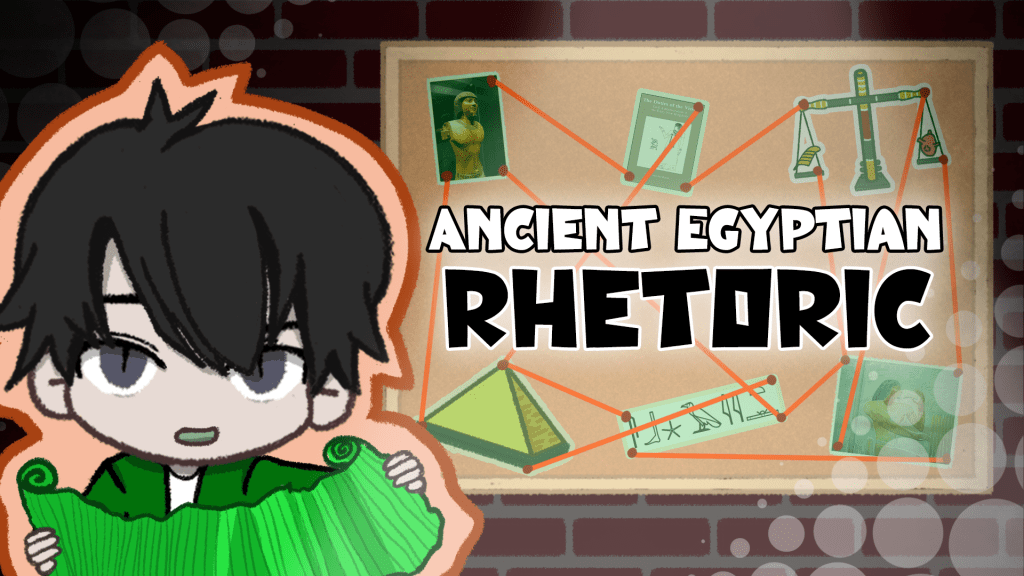

Script
To Be A Scribe!
[odd scene, bg sliding of money or business-like] You could have been an Ancient Egyptian scribe! [fade to bg front, me spinning toward chalkboard] Writing down random stuff all day like an office worker [11], but don’t be deterred, have an open-mind here! Come on! [holding Papyrus Lansing] According to Papyrus Lansing [1] [12] 3900 years ago, being a scribe in Ancient Egypt was an excellent job! You wanna know why? [spins around to odd scene, brushing the floor with paper saying “Nebmare-nakht” on face”] Because according to this dude (Nebmare-nakht), everything else sucked! [“BOOM”, red title “UNAPPROVED JOB”]
[Zoom out into a collage of job icons] “Look for thyself with thine own eye, all the professions are set before thee” [4.2]
- “The washerman spends the whole day going up and down [red title: TOO PHYSICAL] [4.3]… The potter is smeared with mud like a man one of those folk has died [red title: TOO DIRTY] [4.4]… The merchants fare down stream and up stream and are busy as can be [red title: OH MY GADDD] [4.8].” [table scene zoom out] Okay we get it – lots of jobs are dirty and tiresome!
And then the dude writes about how farmers could die a horrible death… [reading Papyrus Lansing book in hand] getting stretched out and beaten… oh my god what [7.3-4]? [odd scene with text sliding through, scary and shade under eye] “If thou hast any sense, be a scribe” [7.6]. “Put writing in thy heart, that thou mayest protect thyself from hard labour of any kind” [9.1]. [add a scream sound effect for no reason LOL]
[table view] Beyond fear tactics, the dude continues by saying how being a writer is the most profitable profession, and that it’s better than bread and beer [2.1-4] And to all the mothers out there, to be a scribe “is more pleasant than a mother that hath given birth” [3.2]. Bruh, it’s like he’s Sergeant Apone from Alien: [clip of Alien 2 with Sergeant Apone wearing scribe on face] “Another glorious day as a scribe! A day as a scribe is like a day on the farm. Every meal’s a banquet! Every paycheck a fortune! Every word makes me a sage! I love being a scribe!”
[front view] So, after all that, all I have to say is… goddamn dude. Why do you want us to be writers so badly? Oh my god! Throwing shade on everyone like that and calling it “the goodly profession” [8.1] and that a scribe will be “at the head of others” [8.1] – there must be a good reason other than random self-importance? Surely, writing down the boring transactions of daily life, like typical admin stuff at an office job, isn’t really fulfilling, right?
Learning about Ancient Egypt
[table view] So I’m taking a course on the history of rhetoric, and we were learning about [odd scene, tiny me, text falling saying “Rhetoric of Ancient Egyptian] Ancient Egyptian rhetoric… wow! [table view] We didn’t go into too much detail, my professor just briefly mentioned Papyrus Lansing to make a point about the value of the written word [img: Papyrus Lansing (Illustration) – World History Encyclopedia]. But honestly, it made me realize that I knew nothing about Ancient Egypt, let alone the rhetoric they lived by. [timeline with Ptahhotep 5th Dynasty, Greeks Tisias and Corax, modern time when I was born] They lived a long time ago! I didn’t even know they were associated with rhetoric theory – like I thought that was attributed to Greeks. Apparently it was traditionally attributed to the Greeks according to this old paper, which proposed that we should also consider Ancient Egyptians as early pioneers [show on monitor]:
- “Rhetorical theory is traditionally thought to have originated with the Greeks. Without attempting to deprive Corax and Tisias of their place of honor, I would like to claim for the ancient Egyptians their rightful place in the history of rhetoric.” [4]
But after the Ancient Egypt section of the course, I thought I’d continue learning on my own; building off the text the course introduced me to: [holding book] “The Teaching of Ptahhotep” [2].
A Vizier
[img1[13]: scrolling top-bottom] Ptahhotep was the vizier of King Izezi of the Fifth Dynasty. [comic bubble with me] What does that mean? I don’t know – so I found the [reading book] “Instruction of Rekhmira” – I’m seriously going to butcher these names oh my god [bubble gets bigger] I’m sorry! [table view] But it was like a description of what an Egyptian vizier is and does. According to this, Viziers were basically the dudes that were above other dudes that did stuff for the king,
- [shows on monitor] “The vizier as head of the civil administration controls the civil government of the country. Ultimately, it is the divine king who heads the government. In this situation, the vizier acts as his delegate and representative” [6].
and more relevant to rhetoric: [img2[14]: scrolling with 3 bubbles of me representing each quote] “in cases of unjust or incorrect official actions the vizier acts ultimately as a court of appeal. In cases of criminal official actions the vizier is chief justice with the facilities of the “great prison”-filing system at his disposal. In cases of personal offence on the part of an official, the vizier is chief justice to any official” [6]. [table scene] So, basically, a person that has a lot of
[on monitor, make a graph of the vizier’s responsibilities] knowledge and wisdom who has many roles, particularly to judge whether you are guilty or innocent. And sometime in 2400 BCE, over 4000 years ago, Ptahhotep held this position.
Sebayt
What the heck is “knowledge and wisdom” though? This is like a question we’d have long debates about in modern times – [scroll through “im14andthisisdeep[15]] anyone could be or convince people that they’re knowledgeable and wise these days; [bubble of paper on my face “vizier”] so why can’t I be a vizier huh? [table view] But from what I read, it wasn’t too ambiguous back in Ptahhotep’s time: Wisdom was something could be acquired through listening to people of great reputation and authority, and their ideas can be written in sebayt, [show on monitor] which is written like this in hieroglyphs, which stems from this verb with a little man over there, probably a pretty wise dude… [7]
[fade to odd scene: “Old Man Says Wise Words -> Write that down! -> Sebayt (“Wisdom Literature”)”] And sebayt is a sort of communication that could apply to any type of lesson or guidance formulated orally, then compiled in written form to produce “wisdom literature”. [img3[16]: scrolling, me as bubble] It could refer to moral or ethical advice, but it also encompasses practical or professional instructions, like administrative guidelines, religious hymns, or training for specific roles such as viziers or priests [7]. [front scene, zoom in and I’m at the corner yelling] You already know of a sebayt – the “Instruction of Rekhmira” that detailed the role of viziers. But yeah it’s basically a sebayt. [odd scene, replacing first word] And that first word basically identifies with sebayt; like the term “Teaching” is sebayt and “Instruction” is sebayt. [bubble of me] I guess everything is sebayt then idk – translations bruh.
The Teachings of Ptahhotep
[table scene] Speaking of translations, this text was my very first academic introduction to Ancient Egyptian rhetoric… [quote on monitor] “commonly regarded as a central composition in the ancient Egyptian ‘stream of tradition’, it contains some of the most ancient known dissertations on the ethics of communication” [7]: [odd scene: me as bubble with corkboard of Ptahhotep] it is The Teaching of Ptahhotep… or Instruction of… of Sebayt – the THING that Ptahhotep said that’s supposed to be wisdom in the form of literature!
[table view] Anyways, he apparently had 37 maxims, and I read them all! It was quite interesting! But a lot of the lessons are related to the assumption that your goal is to gain respect from the elders and… well, [odd scene: Ptahhotep in the back, me sliding upwards then turns around to talk to him] become wealthy HAHAHA yeahhh dude you know me well Ptahhotep!
[odd scene: scrolling through maxims, then stop at 2nd maxim to highlight] There’s a lesson that says submitting to an angry superior will, get this: allow you to “equal his wealth” [maxim 2] – [me as bubble shows up] CACHING goddamn! [bubble switches to other side, new quote] And you don’t even have to say anything to get rich: “There is great respect for the silent man. He who possesses character possesses wealth” [maxim 9]. Remember that people!
[table view] Because awww – are poor people mad at you for being rich? Here’s what you do: Nothing. Just be quiet. No seriously, that’s what it says: [show maxims on monitor] If you come across an angry dude who is not your equal, “Leave him alone” [maxim 4], “Do not answer him back merely to lighten your heart” [maxim 4], “Do not vent your anger against your opponent” [maxim 4] – and no this is not just because you should be nice to people; here’s the thing… “What you wish will be done (anyway), you will beat him through the elders’ disapproval” [maxim 4].
Yeah, you heard that – you basically have the elders as bodyguards [odd scene:
rock “YEAHHHH” sound with old people bodyguards, then zoom in-between as I read]. Wait, what was the average life span? Oh… [10] [oh… gravestones with bell sound effect] Hold on, Ptahhotep said he enjoyed 110 years of life… okay then [YEAHHHHH]. [table view showing article, then various numbers] [put little note about the complications of this [5], ]
Okay beyond all the other stuff, [reading paper] like the 32th maxim basically just tells you to not be gay, and the 21th maxim tells you to put ointment on your wife because it’s the “proper” prescription for her body “for she is a fertile field-” [odd scene, bg disgusting, shade on face, holding away paper because disgusted] BLEH, ah cultural differences dude.
The Essential Goal of Egyptian Civilians
[table view] Looking at the subtext of all this, it really feels like there’s an assumption that success is inherently defined. [front view] Like, I know you want to have a young looking wife so give her ointment; I know you want to climb up society’s ladder, submit to authorities and be quiet; I know you want your kid to agree with you, so punish him if he doesn’t…
What if you like… don’t want to live in ancient Egyptian society? What if you want your kid to grow up into his own person and not always agree with you like a yes-man? What if you don’t like conventionally attractive women – like surely we don’t all want the same things? Sometimes it’s sad if everyone just acted the same way, you know? [table view showing quotes] And why can’t we be gay? Explain that! What is this “cooling his lust” and “mastered his desire” [maxim 32]? [odd scene: list of all the things it tells you to do] It’s all “don’t do this” rather than “why shouldn’t I do this?” [bubble me] Tell me why!
The Power of Words
[table view] Well, the one thing Ptahhotep made sure to explain throughout the whole thing is why you should stay silent. There seems to be a big emphasis on how discourse is performed. For example, if you’re having a meeting with superiors: [quotes on monitor, maybe star wars council meme] “Speak (only) when you have thought of a solution, for it is (only) the skilled who should speak in the council” [maxim 24]. So like, [star wars meme] “You are on this council, but we do not grant you permission to speak.” And there are other cases that emphasize what exactly you should speak about, such as: “Report (only) a matter you have seen, not (merely) heard” [maxim 23]. So basically, no gossiping. [Odd scene: elder with a knife slowly backing away] If someone told you that there’s a serial killer on the loose, just say nothing – don’t report it!
[front view] Jokes aside, it’s basically “Do not speak against anyone great or small: it is bad for the spirit.” [Maxim 3], [walking into the frame] you gotta be cautious about what you say. Whether it be due to a risk of giving false information, accidentally making a fool out of yourself, or pissing people off. Kind of like the modern twist of it: “if you don’t have anything nice to say, don’t say anything at all!” But replace “nice” with “wise” – whatever wise means to the council.
[table scene, slide into view] Beyond Ptahhotep, this paper [7] highlighted other teachings that made more explicit warnings against speaking. [quotes on monitor] The Teaching of Hordjedef [img: Teaching of Hordjedef | SMÄK] says “discourse is the likeness of fire”. The Teaching of P. Insinger says [img: Expedition Magazine | Lost and Found Fragments of Egyptian Wisdom] “the tongue . . . of the fool is the sword which ends (his) own life” and “no remedy is found for the wound caused by the tongue of the hot-headed”. Basically, “Words create, and destroy” [7] – metaphorically like fire.
So, let’s think about this: For some reason, there’s this great fear of the spoken word; it supposedly causes a lot of bad omen if you open your mouth at the wrong time. The alternative is true too: apparently words have a lot of power BECAUSE it is so effective at stirring up things; words have power. According to Ptahhotep, “If you are powerful, gain respect through knowledge and pleasant speech” [maxim 24]. And this respect for speaking has led many throughout history to develop theories on the effectiveness of persuasion, or rhetoric… and a big example, probably one of the earliest examples, is Ptahhotep’s maxims 4000 years ago. Okay…
Modern Day
[front view] I’ve dabbled in rhetoric before – like I took a class on the rhetoric of health and medicine – which focused on the history of lobotomies, trans-health, the concept of objectivity, subjectivity, and relativism in science.
We even got this rhetoric triangle thing. But the resources were all within the past like 100 years. [table view] So in the rhetoric history class, learning about how Ptahhotep said all this about language – They’re dealing with the same things we are – they value the power of the spoken word and they’re scared of it falling into the wrong hands!
[odd scene: Ptahhotep slowly disappearing like from NGNL Steph’s grandfather] And we’re still having trouble with it though! I’m sorry Ptahhotep, come back! We need you to write more maxims! [table view] In the age of the internet and open-access to all sorts of information, basically anyone could gain respect through “knowledge and pleasant speech” – anyone could redefine what “knowledge and pleasant speech” even means. It makes it harder to comfortably settle into any one belief. [show Kurzgesagt video on monitor] Like there’s this whole conversation about how polarized the internet has made the world. But I don’t think it’s like a comfortable polarization – [make a meme where there are 100s of squares “I can be anywhere but I’m here because… I don’t know”] I kinda think people might just polarize themselves because it’s easier in this scary world, rather than primarily doing it for the sake of promoting their [another meme next to the previous where there are no squares: “I’m here because it’s the only place that exists for me”] “One Truth” that they know to be right. [front view] We are exposed to so many things, I don’t think our brains are so amazing that we can ignore absolutely everything contradictory around us. Honestly, I wish we could be that simple – it’ll be easier! [odd scene: shiny spicy food] Like, I still have trouble deciding if I like spicy food or not; it’s complicated dude! [Makeine girl sees me from restaurant] And then some guru comes along and says [Makeine girl staring at me] “make a tier list of spicy food, and if I don’t agree with it, you’re a loser – you don’t deserve to be asian!”
Silence Virtue
[pictures of Ancient Egypt] But how did they deal with it? Ancient Egypt, [me bubble] PFFFF, as if they were any better! [table view] Well… actually, maybe not “better” according to our goals, but I think they sort of succeeded in what they wanted. [quotes on monitor] They were around for thousands of years, longer than any human civilization apparently.
[Based on Timeline of ancient Egypt | British Museum]
- 3100 BCE – Egypt is united
- 2700 BCE – Artificial mummification
- 2055 BCE – Upper and Lower Egypt are reunited
- 1500 BCE – Expanding the empire
- 600-300 BCE – The end of native rule
[front view] According to Ptahhotep, “Good speech is rarer than greenstone”. This kind of establishes the whole point: Just shut up and do your job! Like, if you’re a citizen and don’t have any crazy ambitions in life, I think the idea is to stick with that. To live an ambitious life, to spread information like you’re in the 21st century and that not resulting in you being socially outcasted is, I guess, rarer than greenstone – you can’t convince everyone to accept you as a knowledgeable and wise person unless you’re as persuasive as a great sage. [opens book, flips pages, then closes book] An advice from the great vizier that supposedly managed to live longer than most of you ever will, “Your silence will be more effective than idle chatter” [maxim 24]. I guess if there isn’t any exposure to new information, it’d be easier and less internally conflicting to just never think about whether you’re right or wrong. I mean, you’d get rewarded for abiding by the principle of silence.
[odd scene, confused] However, that seems a bit off. Why stay silent when Ptahhotep kept praising how “good speech” is this and that? How do you get better at speaking when you’re silent the whole time? [table view, quote on monitor] Well, apparently: “He who listens well speaks well. The listener reaps the benefit – listening benefits the listener – for listening is better than anything else; it creates good will. How good it is for a son to take heed of his father’s words! He will attain old age as a result” [epilogue]. What… Yeah that… that totally makes sense…
Anyways, if we follow the logic established earlier, then the elders would be the ones enforcing the value of silence – the elders will disapprove and deal with those who sing too loudly. [front view] Okay, but hear me out: Who will make sure the elders and Ptahhotep are doing what they promised? What, are they the ultimate decision maker on what’s good or bad? Are we really supposed to rely on them, instead of discussing this amongst ourselves? What if I’m punished for being silent? Surely, in modern times, we know we’re all human – there’s no way to judge so fairly. Right…? [lights turn off, computer screen flickers on, then table view, slowly zooming out with notes on monitor fading in] Oh boy… I’ll be right back… [black screen, fading to dark room with window, credit scene]
Citations
[1] Papyrus Lansing: A Translation with Notes on JSTOR
[2] Writings from Ancient Egypt: 9780141395951 | PenguinRandomHouse.com: Books
[3] A Modern Look at Ancient Wisdom: The Instruction of Ptahhotep Revisited on JSTOR
[4] Ancient Egyptian Rhetoric on JSTOR
[5] The life expectancy myth, and why many ancient humans lived long healthy lives | Ancient Origins
[6] G. P. F. Van Den Boorn. (2014). Duties of the vizier. Taylor and Francis. https://doi.org/10.4324/9781315029856
[7] Discourses on ethics and ethics of discourse in ancient Egyptian wisdom
[8] Quack, J.F. (2021) ‘Wisdom in Egypt’, in W. Kynes (ed.) The Oxford Handbook of Wisdom and the Bible. Oxford: Oxford University Press, 103–120.
[9] The Project Gutenberg E-text of The Instruction of Ptah-hotep, by Battiscombe G. Gunn
[10] Old age in ancient Egypt | UCL Researchers in Museums
[11] Scribes in ancient Egypt | Ancient Egypt Online
[12] The Papyrus Lansing: Be A Scribe…Or Else! – World History Encyclopedia
[13] Mystický EGYPT: Ptahhotep – Muzeum v Sakkáře
[14] Rekhmire: The First Masonic Grand Master of the Deep State | Gnostic Warrior By Moe Bedard
[15] im14andthisisdeep
[16] Ptah-hotep seated.
[17] The Installation of the Vizier on JSTO
[18] Timeline of ancient Egypt | British Museum
Music:
- Sora Yori – Ii Tenki da ne
- Sora Yori – Karuku Shinemasu ne
- Adachi to Shimamura – 小さな高揚
- Tensei Oujo – Magical Lecture
- Tensei Oujo – Let’s Take A Break
- Sora Yori – Hotto Hitoiki
- Sora Yori – e-tto… e?
- Sora Yori – Muri Muri Muri!
- Sora Yori – Daakaaraa!
Sound effects:
- Cartoon hearts overflow | Royalty-free Music – Pixabay
- balloon splrt 3 medium | Royalty-free Music – Pixabay
- Wind blowing sfx | Royalty-free Music – Pixabay
- Accident fall drop topple | Royalty-free Music – Pixabay
- Bloop 1 | Royalty-free Music – Pixabay
- Wilhelm Splash | Royalty-free Music – Pixabay
- Cinematic Boom | Royalty-free Music – Pixabay
- Cinematic Hit | Royalty-free Music – Pixabay
- Magical Twinkle | Royalty-free Music – Pixabay
- Trumpet Fail | Royalty-free Music – Pixabay
- Notification | Royalty-free Music – Pixabay
- woosh | Royalty-free Music – Pixabay
- Small Film Projector | Royalty-free Music – Pixabay
- Light Switch Sound | Royalty-free Music – Pixabay
- Liquid wobble | Royalty-free Music – Pixabay
- writing | Royalty-free Music – Pixabay
- i see money | Royalty-free Music – Pixabay
- Tap Notification | Royalty-free Music – Pixabay
- 20131118_trashcan smashed_ZoomH2nXY | Royalty-free Music – Pixabay
- Sword Schwing | Royalty-free Music – Pixabay
- A Soldier Song (slow0 | Royalty-free Music – Pixabay
- the best military beat v2 on free sound made by kris klavenes | Royalty-free Music – Pixabay
- MadeInAbyss | Royalty-free Music – Pixabay
- Tea Kettle Mono 44 | Royalty-free Music – Pixabay
- Old Church Bell | Royalty-free Music – Pixabay
- Old desktop pc booting | Royalty-free Music – Pixabay
- C=64 Floppy Disk Drive Power On | Royalty-free Music – Pixabay


Leave a comment