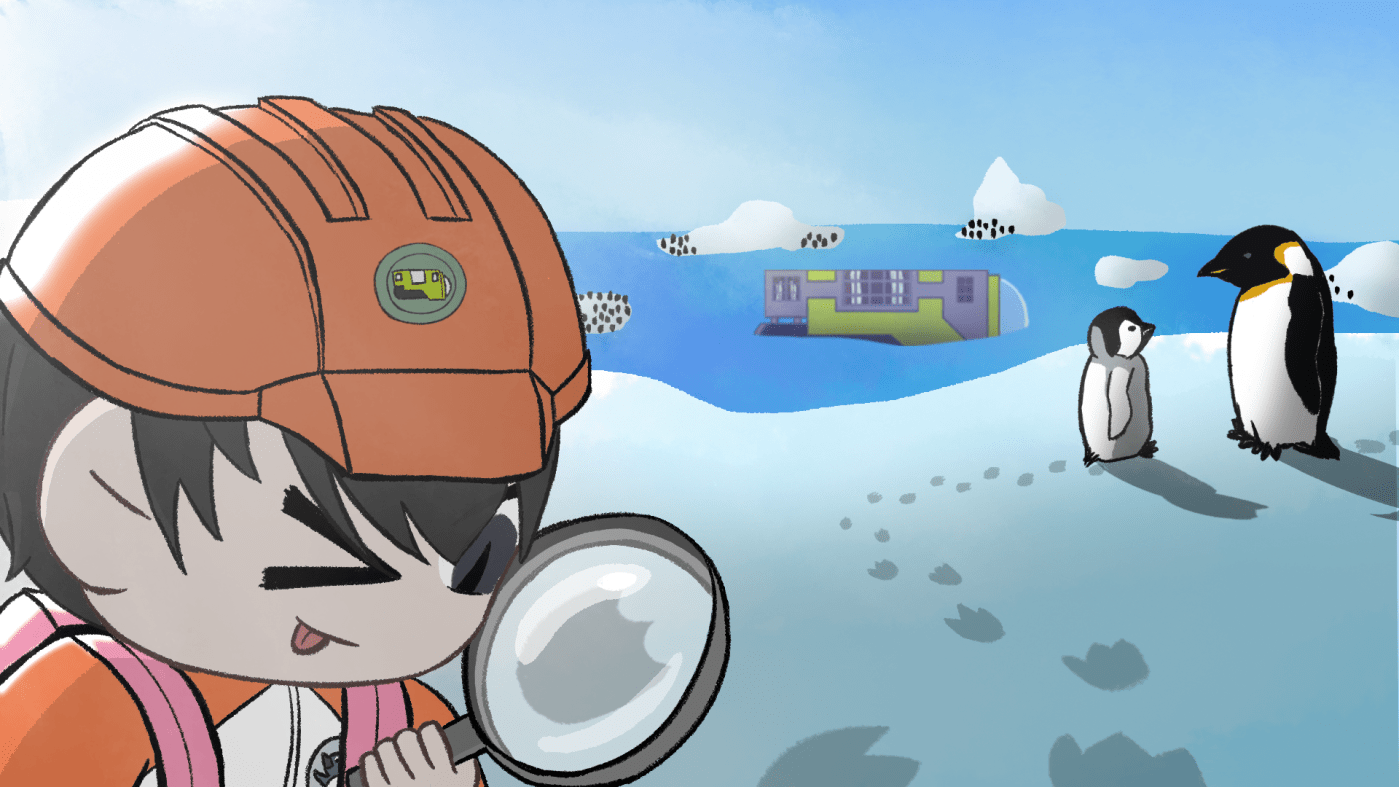
Overview
Video: https://youtu.be/YRoQZGaxVK0
Ironically, even after completing the research and video portion of this project, I still made a lot of mistakes worthy of the title “ignorant penguin enthusiast”. I additionally did not succeed in invoking the sense that I am simply learning about penguins – many parts of the video had the narrative that I knew exactly what I was talking about (and pair that with simple mistakes). I’d ideally like to avoid that, and instead promote the sources I got information from – prioritize the narrative that I am learning (because I am). So, while this video is certainly a step up in visual related effort, the script remains unsatisfactory. I was overly excited to make this video and rushed the script and recording.
For those reasons, I was contemplating starting over. However, I thought about the learning opportunity of this video (mostly for myself) and decided to finish it (or, tried to finish it). Publication of this is mostly for the sake of sharing my learning and efforts, as it feels quite wasted otherwise. An idea partly inspired by the “art progress” sorts of media – I want to experiment with this in other things like science, perhaps to dispel the (my) attitude and insecurity of learning new things. Basically, I don’t want to share my hobby in a perfectionistic manner. Therefore, it would be wise to avoid directly quoting what I say; the point of my video is not to provide education, but rather encouragement for education. But feel free to use the sources I’ve gathered! If anything, I think the sources are really cool!
Future videos may steer towards this direction – there are certainly many amazing and qualified science communicators, and I am not one of them. Instead, I just want to share the process of learning. Unfortunately, my video didn’t depict that as well as I’d like it to, and may unintentionally invite people to take it as a primary source. Regardless, I hope this additional information is helpful, and if anything… this is an interesting “case study” of how it’s like to re-learn something you thought you knew, and how you could still end up making many mistakes. Don’t let that discourage you, it’s part of the “process”!
Note: I won’t be commenting on pronunciation mistakes, grammar, visual, or other things like saying “I won’t even attempt to understand” when I meant pretend – this blog post is mostly addressing sources and source-related presentation in the script.
Comments and Critiques
Climate change? Animal cruelty? What the heck is going on? I would expect to see the kiwi or a sea lion, not a penguin… “New Zealand is home to three species of penguins” [2]
I’m certainly not encountering penguins for the first time – I’ve even seen them at an aquarium (one of the banded penguins, Spheniscus). However, I’ve never really given the Spheniscidae family (all extant, living penguins) a thought beyond their typical depiction in popular media. When someone says “I want to see penguins,” my immediate thought is Antarctica, not South Africa. For that to be the case is quite astonishing, but understandable. But recognizing this, perhaps it’s time to stop looking at penguins purely as symbols, but expand the perspective to something that may be a bit more productive towards learning about them. This was a sentiment I should have emphasized a bit better!
As a whole, the Spheniscidae family is greatly varied by virtue of their distribution in the southern (and central) hemisphere, and particularly notable in both the modern and the paleontology sense are New Zealand’s extant and extinct penguins. One of my first encounters with this information comes from [2], a website that introduces New Zealand’s mainland penguins: Little Blue, Yellow-Eyed, and Fiordland penguins.
There are indeed other species beyond the main island but still within New Zealand oceans: The Snares penguin exclusively breeds on Snares Island, sandwiched by Auckland Island and mainland New Zealand [4]. I’m not sure why they aren’t included, but I suspect its due to their absence on the main island. Regardless, I should have included the Snares penguin in this part.
I think it’s illegal for me to approach them, so I’m hiding… but wait, it’s fine if they are the ones who approach you, right? “the rules do not preclude a curious penguin from approaching within five meters of you” [3].
You may not approach, you may not try to be approached, but you may be approached – Perhaps that is the sentiment of this rule around penguins? Essentially, you cannot control an Adelie penguin chasing you off the face of the Antarctic continent – it’s inevitable that they might try it! Yet, since you are an autonomous being, you can learn to avoid such situations. After all, we are responsible for any potential influences we have in an environment lacking in human presence. Think international ambassadors: they represent their country and people. As visitors, I assume that it’s our responsibility to be aware of such – penguins probably think we represent our entire species!
The International Association of Antarctica Tour Operators [55] provides guidelines, “Operational Procedures for Viewing Birds”, which can be found on their Visitor Guidelines Library page. According to their “recommended approach distances”, penguins (in moult – individuals and groups) are actually the most laxed in regulated distance – 5 meters. Compare this to “displaying albatrosses”, which require visitors maintain a distance of 25 meters. But on the topic of precluding penguins from approaching you, there is this: “Inquisitive animals, especially penguins, may approach you. Maintain the minimum required distance (at least 5m). Be prepared to back away slowly after checking behind you” [55]. I assume it’s generally your responsibility to avoid getting into situations where you are unable to maintain the 5 meters, but it’s probably up to the supervisors.
Learning about Modern Penguins
So I went on a quick research adventure, the good old online search, [normal] and found this penguin guide from 2022 [4]. Apparently there are 18 recognized living penguin species in the world with 6 genera representing their great diversity.
[4] contains detailed descriptions of all 18 officially recognized penguin species (I don’t believe there were discussions on the genera, other than stating that there are 6, along with various articles relating to conservation and research into extinct and extant penguins. Honestly… it’s pretty useful!
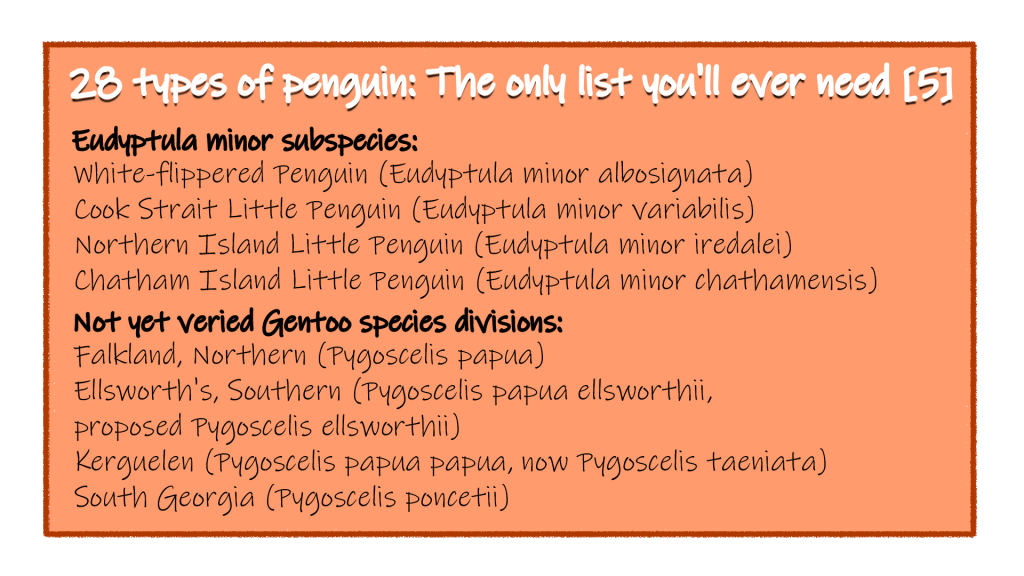
Some sources [5] say 28 species, because taxonomy is HARD with sub-species debates and all that regional variation stuff.
Here is my carelessness revealing itself: The article did not say species! They clarified at the beginning of their article: “Whether species, subspecies or colour morphs* – here are the 28 “types” of penguins that walk the earth” [5]. Funny enough, it’s even printed on my visuals – I said “species” while my drawings said “types”.
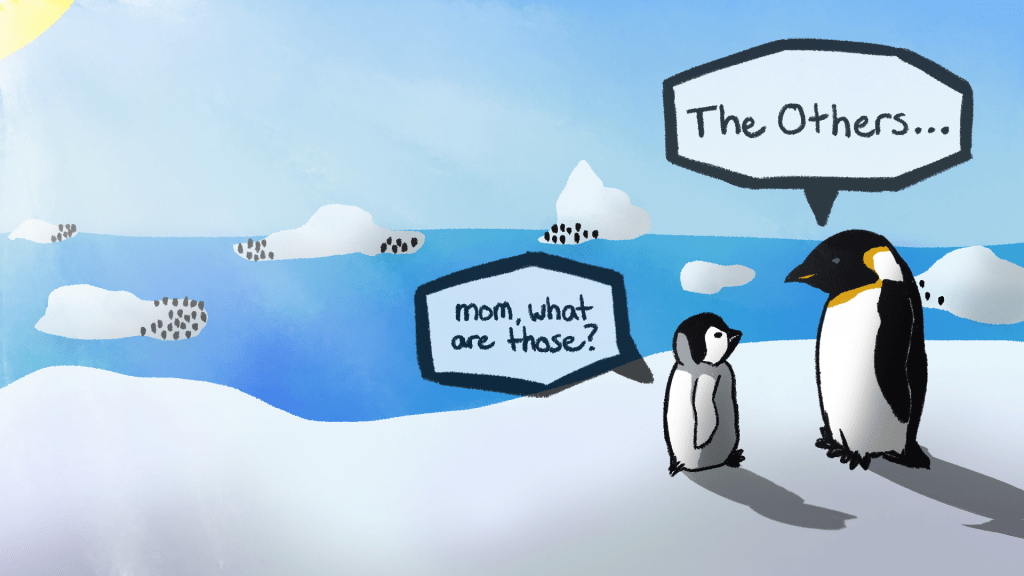
only the Emperor and Adelie penguins can be found deep in the Antarctic continent [4, chapter 3]. The others… some of them don’t even step foot on Antarctica!
There is certainly a bit to unpack regarding Emperor and Adelie penguins being the only ones found deep in the Antarctic continent (which sort of makes sense). According to [4, p.200], Emperor penguins are the “only one to breed during Antarctic winter, enduring harshest conditions of any species” and “many Emperors spend their entire lives without ever touching terra firma.” While Adelie penguins are the “Southernmost of all penguins” [4, p.204]. For deep in the Antarctic continent, I also relied on the “population and distribution” section, which states that the Emperor and Adelie breeds around the Antarctic continent. Obviously, other penguins can be found residing on the Antarctic continent, as stated in the note: “Other species also found in Antarctica, mostly along the peninsula: Chinstrap and Gentoo. Although some are vagrant: King and Magellanic [4].”
I… should have been more specific. I wrote the script and recorded the audio months before actually drawing this part – and by that time, I realized that I was merely using my intuition that Emperor and Adelie penguins are the only ones on the Antarctic continent. It was a statement charged in the desire to push the narrative of “oh my gah, penguins aren’t only in Antarctica???”
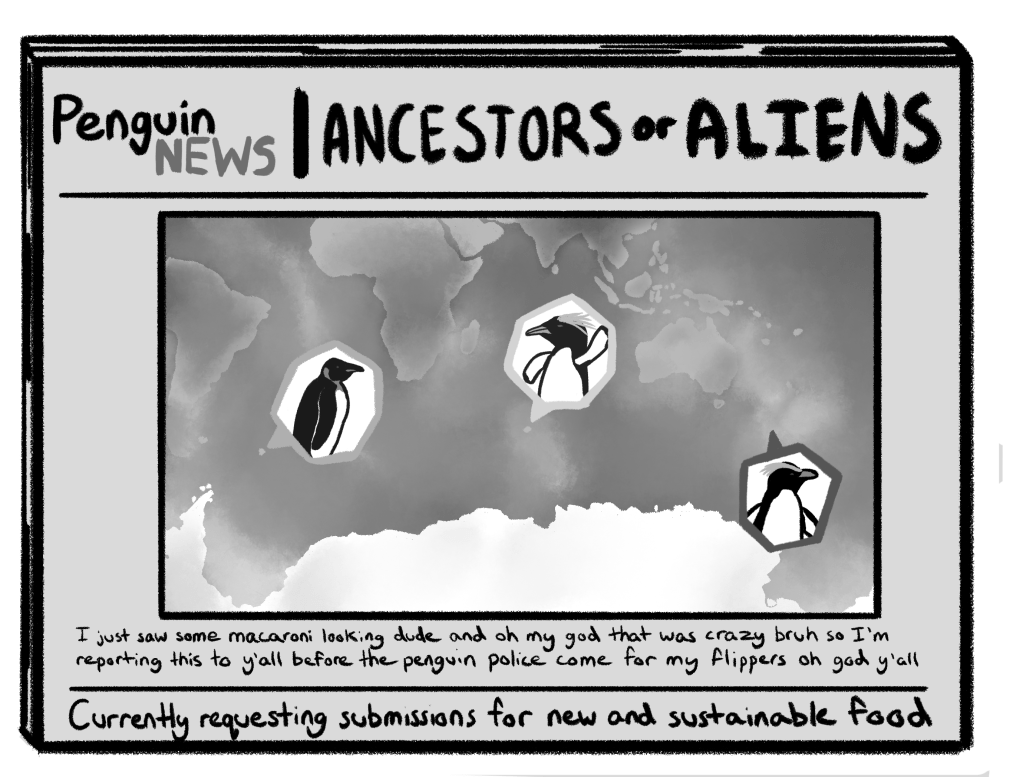
Above image shows King (South Georgia) [7], Macaroni (French Southern and Antarctic Lands) [6], Fiordland penguins (Stewart Island) [39].
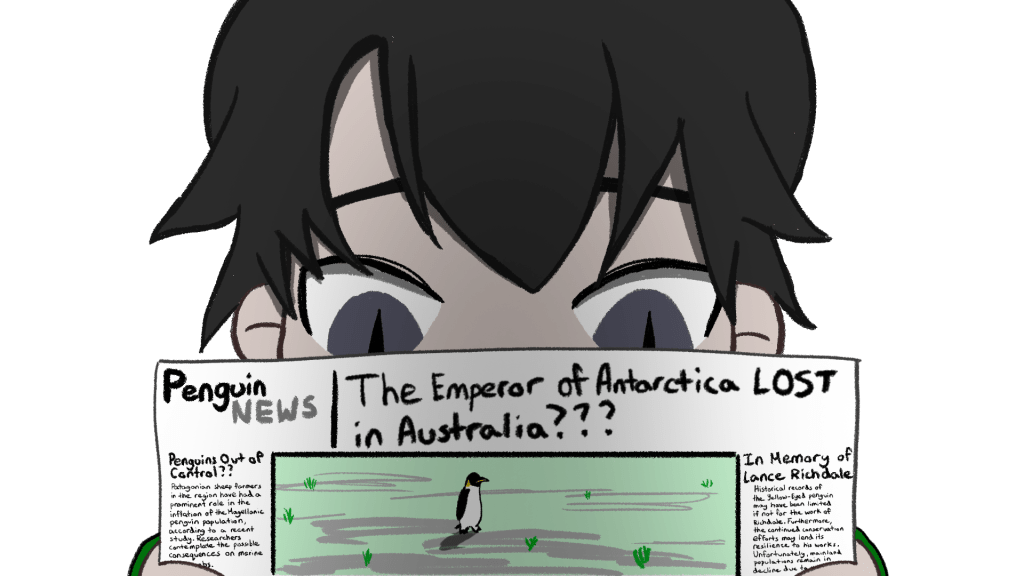
Last year on November 1, “Gus the penguin” (emperor penguin) ended up on an Australian beach (all the way from Antarctica!!) [9].
The left side, “Penguins Out of Control??” is in reference to [57] and [58], articles discussing the ecology of Magellanic penguins and their interactions with sheep farmers, conservationists, and pumas in Patagonia. My interpretation of these papers is that conservation isn’t necessarily only about protecting animals, but protecting the ecosystem as a whole, though sometimes about particular animals – I saw some comments from people suggesting that conservationism can be criticized based on its tendency to prioritize charismatic species, and that we shouldn’t be trying to interfere by being conservationists. It seems like a complex topic that should welcome new findings like these papers, and I’m curious whether this changes anything about Magellanic penguin conservation. I doubt it really does, but I haven’t looked further into the topic – I just wanted to share this!
The right side, “In Memory of Lance Richdale”, was inspired by [35], which discusses the role Richdale played in securing the future of Yellow-Eyed penguins.
Approximately 56-78 cm, has a diet of red cod, blue cod [4, chapter 3, p.232-3], Call Of Duty Black Ops […] it’s officially called the Yellow-Eyed Penguin or the Hoiho [43].
Once again, [4] is a great source. Here is a further detailed look at the Yellow-Eyed penguin’s diet: “Diet varies depending on season and location but mostly consists of red cod, opal fi sh, sprat, silversides, blue cod and ahuru, with some squid and krill”.
The “Call Of Duty Black Ops” was a joke on how “cod” is the game’s name when made into an acronym. Honestly, it’s not really that funny, so I’m not sure why I added that joke…?????
The name Hoiho means “noise shouter”, a Māori name according to [43]. It also included takaraha (or takaraka) and tavora as additional Māori names. Looking further in [35], the names tawaki and korara were apparently cited as Yellow-Eyed penguin names – but I believe the former actually refers to the Fiordland penguin while the latter refers to the Little Blue.
Learning Something Half-Dead
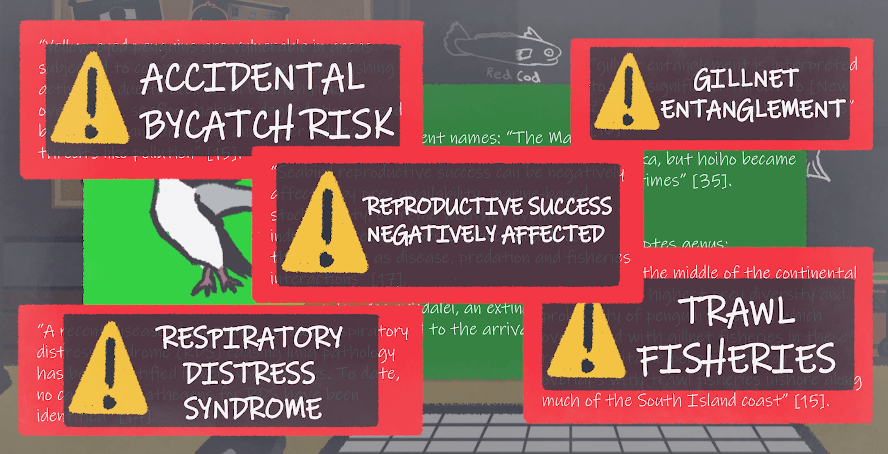
Of the information I’ve encountered about this particular penguin, a large majority of them highlight issues of conservation [14] [15] [16] [17]
A better look at the quotes I gathered from these papers:
- “gillnet entanglement is interpreted to be a significant threat to [New Zealand] South Island populations” [16].
- “A recent disease phenomenon termed respiratory distress syndrome (RDS) causing lung pathology has been identified in very young chicks. To date, no causative pathogens for RDS have been identified” [14].
- “Yellow-eyed penguins are vulnerable in areas subjected to commercial and recreational fishing activities, due to accidental bycatch risk, overfishing, seafloor habitat degradation caused by trawling and dredging, and other indirect threats like pollution” [15].
- “Areas along the middle of the continental shelf had the highest prey diversity and probability of penguin presence, which overlapped with gillnet fisheries in these regions. Suitable penguin habitat also overlaps with trawl fisheries inshore along much of the South Island coast” [15].
- “Seabird reproductive success can be negatively affected by prey availability, marine-based stochasticity, extreme weather events, individual breeders’ performance and direct threats such as disease, predation and fisheries interactions” [17].
“Extreme population fluctuations, plus severe declines in mainland regions” [4, chapter 3]
Unfortunately, Yellow-eyed Penguin Trust – Dunedin, New Zealand | Home might have updated their website. I am unable to find the original population graph from this page: Population and trends of yellow-eyed penguins in New Zealand. There is, however, a really detailed paper on this topic [59] if you’re interested in further reading.
“Elves, who seldom walked in the Shire, could now be seen passing westward through the woods in the evening, passing and not returning; but they were leaving Middle-earth and were no longer concerned with its troubles.”…“[Sam] believed he had once seen an Elf in the woods, and still hoped to see more one day.”…“‘They are sailing, sailing, sailing over the Sea, they are going into the West and leaving us,’ said Sam, half chanting the words, shaking his head sadly and solemnly.”
So… this part obviously didn’t work. It was a big shift from the tone of the video and I really doubt it was even necessary. However, it’s really interesting – my intentions were to expand the perspective of conservation towards familiar literature. Unfortunately, I didn’t spend nearly as much time on this part as I needed to. As a result, it resembles something like a deleted scene that was accidentally left in the video. Though, I think it’s a topic that can be explored in more depth – a literary analysis rather than a video mixing penguins and Lord of the Rings. For one of my university courses, I actually did this for Sir Gawain and the Green Knight, following Ann M. Martinez and their suggestion of Bertilak as an early pioneer of conservationism. I’d love to look back on this video one day and see this preliminary discussion that didn’t go anywhere, but at least revealed some desire to engage with an interesting topic.
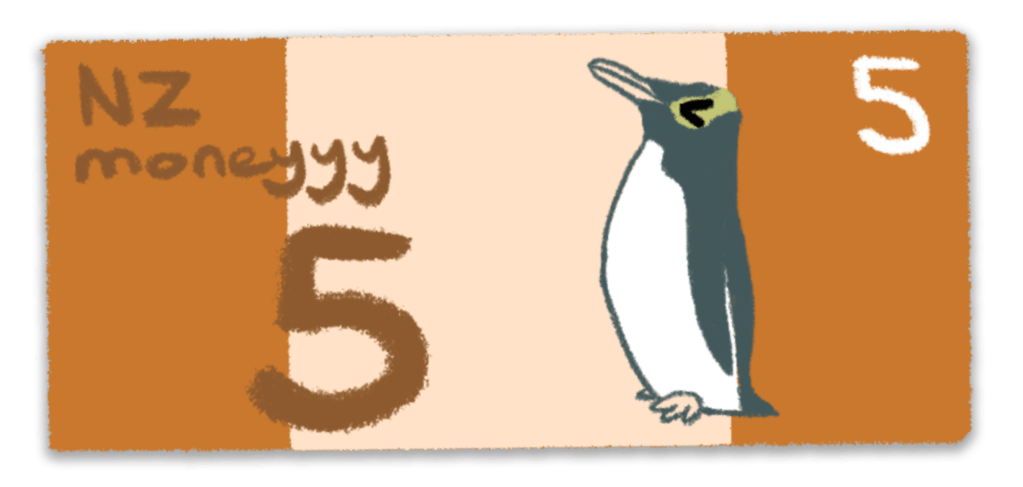
you might even see them everyday on New Zealand currency [45]
Check out [45] for what it actually looks like! I’m jealous I don’t get to see these everyday…
but I heard that penguins are scattered throughout the Southern hemisphere, in many varieties, evolved to swim instead of continuing to fly, some threatened and isolated in small colonies, and…
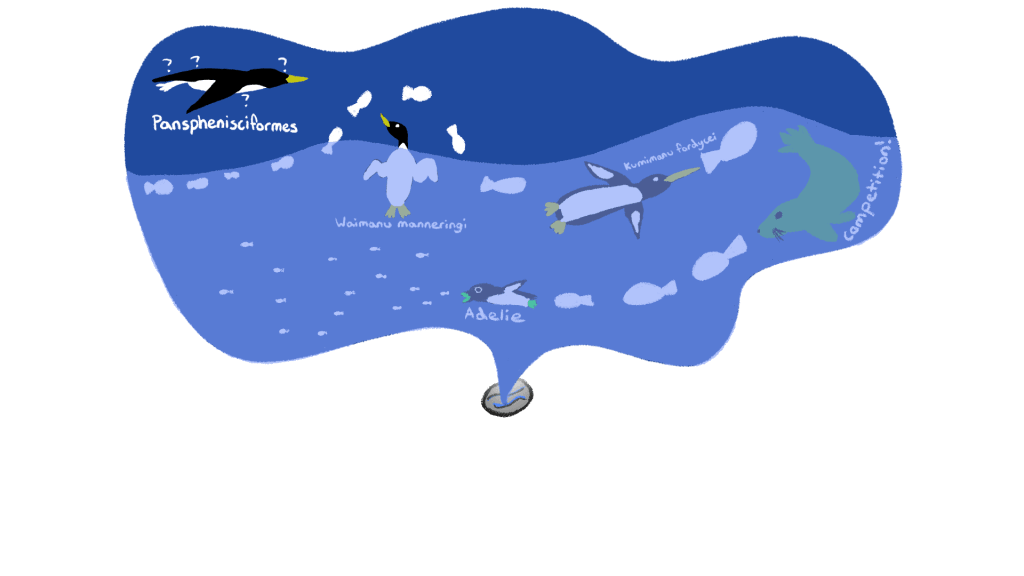
For this quote, I’ll be referring to the visuals:
Pansphenisciformes is a clade name (unformalized, I think?) proposed that represented “taxa more closely related to extant penguins than to any other extant avian taxa” [36, p.3], meaning the last “penguin” (or bird closes to what we consider penguins) that was able to fly. [24, p.165] describes it better: “if volant basal members of the penguin lineage were to be discovered, they would be placed within Pansphenisciformes but excluded from Sphenisciformes”.
The holotype of Waimanu manneringi was found by Al Mannering, which was later described in [26]. The paper suggests an age of 60.5-61.6 Ma, late early Paleocene. [4, p.159] describes it as one of the oldest known taxa, “proto-penguins” that include Muriwaimanu tuatahi and Sequiwaimanu rosieae.
According to [37 p.435], the “largest penguin humerus yet reported” was from Kumimanu fordycei, “the candidate for the largest known penguin” [37 p.440], with an estimated complete length of ~243 mm. Compare that to the Emperor penguin’s 128 mm, and the little blue penguin’s 46 mm [60].
The arrival of pinnipeds and cetaceans to the southern hemisphere could have meant that giant penguins competed with them [24], “perhaps there was an ecological interaction that wasn’t favourable for the penguins: competitive exclusion, direct predation, or perhaps both?” [28]. With some Eudyptes and Pygoscelis species relying on planktonic crustaceans, and that maybe being a relatively recent innovation [24, p.174], that could be the case? But that is my personal thoughts, having mostly skimmed through the literature. Read them yourself – it’s quite interesting and much more complicated than I can ever represent it here. I mostly just wanted to draw some linear timeline for the hell of it!
History of New Zealand Fossils
in 1839, Walter Mantell traveled to New Zealand and settled in Wellington, and in one of his letters to his father, he mentioned that “among the Maories or natives, that gigantic birds, taller than a man, were formerly abundant throughout the islands; and that some of the oldest of the natives averred that they had seen such birds” [21, p.4]. These were flightless birds called the Moa. And in 1847, in hopes of learning more about the Moa and whether it was still in existence, he “explored every known locality of these relics [fossils] in the North Island within his reach”. […] the natives offered no encouragement to further pursue the question, as the information he gathered from them tended to confirm that these “gigantic struthious birds, had become extinct” [21, p.5]
Images used on for this section of the video: Walter Mantell riding a moa – Collecting – Te Ara Encyclopedia of New Zealand [46] and Walter Mantell’s sketch of the departure from Awamoa, 1852 – Anthropology and archaeology – Te Ara Encyclopedia of New Zealand [47]
Walter Mantell acquired 7 to 8 hundred specimens [21, p.10], what his father called “perhaps the most extraordinary collection of the fossil remains of struthious birds that has ever been transmitted to Europe”. […] “the crania and mandibles, egg-shells, and bones, of several genera and species, most, if not all of which have probably been long extinct” [21, p.2]. […] And it was in this collection of fossils that they mentioned that some of the bones resembled those of albatrosses, parrots, water hen, and for the first time ever… potentially ancient penguins [22, p.333]. […] He [Thomas Henry Huxley] was provided, by his friend, Walter Mantell (who we just talked about), with a relatively large tarso-metatarsal bone from tertiary deposits at Kakanui in New Zealand. He stated that in his analysis, which I won’t even attempt to understand, “demonstrate[s] that it belonged to one of the…Penguin tribe” [18, p.673]. And he determined that it was “larger [in] dimensions than any living species which have been observed”… Huxley noted that “its owner might have stood between four and five feet high” [18, p.674]. And in that view, he proposed the new genus of Paleeeudytes to the penguin, and designated the species name as “antarcticus”: So basically Palaeeudyptes antarcticus, which literally translates to “ancient winged diver of the south” [19].
Nothing much to comment on, but just wanted to say how cool these archived works are! That’s the issue though, I merely narrated these quotes, rather than emphasized the source itself. As a result, this entire final portion of the video is overly authoritative in tone, which invites people to directly source me rather than seek original source. Something I need to work on.
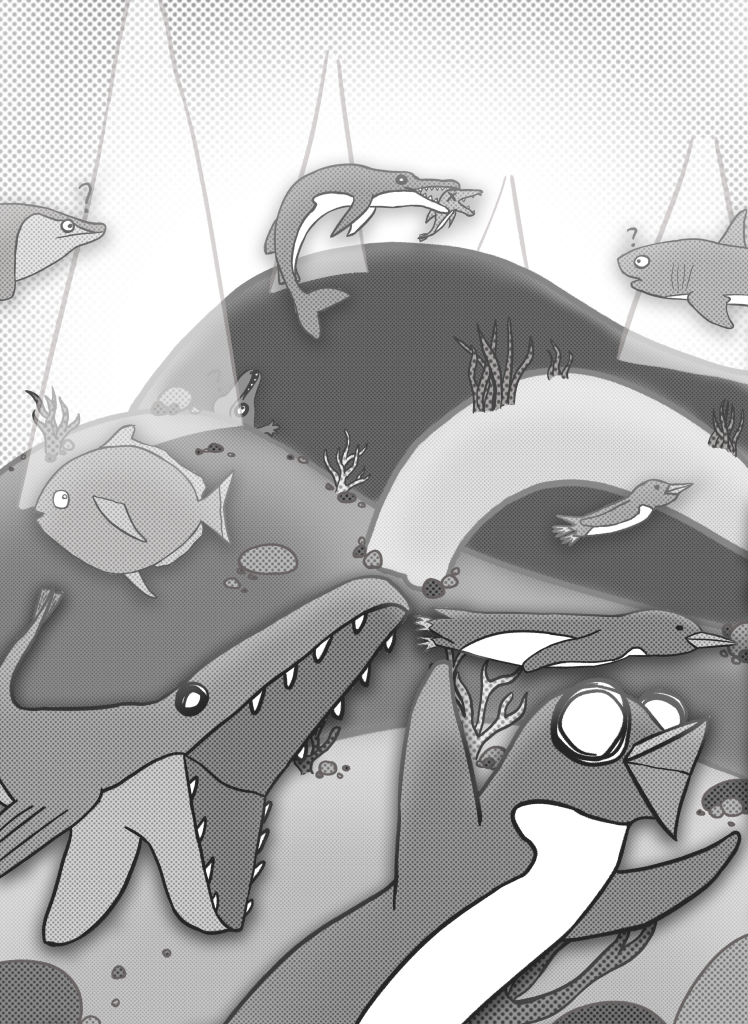
The image above depicts various marine animals that may have been around during the time of Palaeeudyptes antarcticus. Whether they interacted is another question (probably unlikely, but I wanted like to artistically depict them interacting for the fun of it):
- The dude having a snack is Basilosaurus isis: “Harlan compared the bones, which included a very large and strange vertebra, with other large extinct creatures known at the time and concluded that it was a very large reptile of sorts and named it Basilosaurus or “king lizard.”” [48, p. 33]. The snack is Dorudon atrox: “It is possible that adult B. isis bit D. atrox calves across the head and held them under water, and drowning might be taken into consideration as a possible mode of killing in archaeocetes.” [49, p. 13]. “B. isis seemingly fed preferentially on very young attacking them in the head [30], which was probably the fastest way to inflict a fatal injury” [50, p. 18].
- There were various other interpretations for why a certain specimen of Dorudon atrox had a large bite on its head. I wanted to honour those interpretations by including them in the drawing. See if you can spot them: Crocodilus megarhinus, Carcharocles sokolowi, and Ancalecetus simonsi [49].
- The dude chasing the penguin is Kekenodon onamata, which preyed on penguins [51]. Unfortunately looks like Basilosaurus isis (my lazy mistake).
- That weird looking dude is Megalampris keyesi, the giant moon fish [52].
“despite 150 years of field work, no more material of Huxley’s species has been found” [19]. And the age of the original fossil isn’t clear, as it could have originated from 2 different limestones, both separated by about 10 million years (32-34 M vs 23-24 M) [19].
From: “we aren’t even sure of the age of the fossil; it is probably from the soft white Ototara Limestone which, at Kakanui, spans the Eocene/Oligocene boundary – in the range 32-34 M years. However, the bone could be from the harder and younger Otekaike Limestone, with an age of perhaps 23-24 M years” [19].
According to [38, 251], we are limited to 2 verifiable records of Palaeeudyptes antarcticus. Table 1 on page 23 provided an overview of fossils and their revisions overtime, which I used to create the image below.
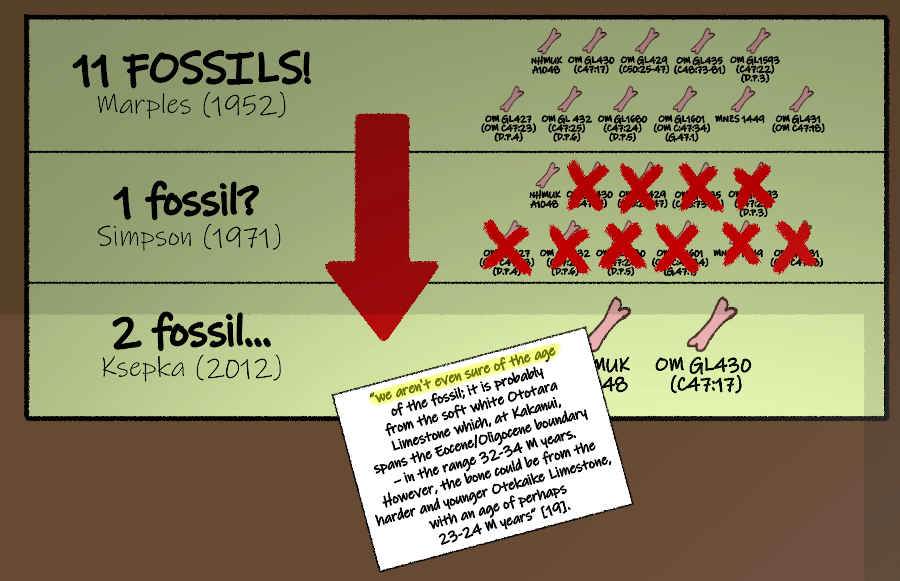
Throughout the years, people have classified certain specimens as Palaeeudyptes antarcticus – ranging from late Eocene Australia [56] to Antarctica [53] [as referenced and criticized by [38, 251]], even though the species came from New Zealand. That’s a wide distribution for just one species…
[38, 251] commented on Palaeeudyptes antarcticus as a “taxonomic wastebasket”, concluding that “[a]n Eocene penguin species with a cosmopolitan distribution would have important implications for the paleobiology and biogeography of stem Sphenisciformes, but there is no solid evidence for any fossil species displaying a wide or circumpolar distribution”. The papers referenced by [38] provided the locations for each fossil.

Citations
NOTE: Unfortunately, my citations suck… I know! Please bare with it for this project. I plan to use proper citations in the future. Also, the original script is actually 4 times longer, which is why there are a lot of unused citations in this version (I didn’t include the entire video’s script either, which used some of the citations). Ignore them – I’ll be using them in future videos!
[1] uhhh… ignore this
[2] Penguins in New Zealand | 100% Pure NZ
- Just a random website where I learned that penguins resided in New Zealand.
[3] Getting personal with penguins in Antarctica
- Visitors regulations… sort of? It’s just an article, but here’s…
[4] De Roy, T., Ainley, D., Boersma, P. D., Boessenkool, S., Chiaradia, A., Cornthwaite, J., Glass, C., Jones, M., Ksepka, D., Le Maho, Y., Lynch, H. J., Morrison, K. W., Ryan, P., Shawkey, M., Thompson, D., Vargas, H., Wienecke, B., Wilson, R. P., & De Gruyter Princeton University Press Complete eBook-Package 2022. (2022). Penguins: The ultimate guide second edition (1st ed.). Princeton University Press. https://doi.org/10.1515/9780691233581
[5] Two Oceans Aquarium | 28 types of penguin: The only list you’ll ever…
[6] Wildlife in French Southern and Antarctic Lands – Types of Kerguelen Animals – A-Z Animals
[7] The incredible king penguins of South Georgia – Swoop Antarctica Blog
[8] Islands of the Southern Ocean – Travel guide at Wikivoyage
[9] Gus the penguin makes mysterious solo trip to popular Australian beach | CBC News
[10] Megadyptes antipodes (Yellow-eyed Penguin)
[11] Aquatic Conservation: Marine and Freshwater Ecosystems | Aquatic Journal | Wiley Online Library
[17] Aquatic Conservation: Marine and Freshwater Ecosystems | Aquatic Journal | Wiley Online Library
[18] Huxley, T. H. (1859). On a fossil bird and a fossil cetacean from new zealand. Journal of the Geological Society, 15(1-2), 670-677. https://doi.org/10.1144/GSL.JGS.1859.015.01-02.73
[20] Bulletin of the Geological Institutions of the University of Uppsala | PaleoArchive
- Vorläufige Mitteilung über die alttertiären Vertebraten der Seymourinsel
- Discovery and classification of Anthropornis nordenskjöldii.
[22] Notice of the remains of the dinornis and other birds, and of fossils and rock-specimens, recently collected by mr. walter mantell in the middle island of new zealand; with additional notes on the northern island. Quarterly Journal of the Geological Society of London, https://doi.org/10.1144/gsl.jgs.1850.006.01-02.30
[23] Jadwiszczak, P. (2001). Body size of eocene antarctic penguins. Polish Polar Research, 22(2), 147-158.
[24] Ksepka, D. T., & Ando, T. (2011). Penguins past, present, and future: Trends in the evolution of the sphenisciformes. In G. Dyke, & G. Kaiser (Eds.), Living dinosaurs (pp. 155-186). John Wiley & Sons, Ltd. https://onlinelibrary.wiley.com/doi/10.1002/9781119990475.ch6
[25] Ksepka, D. (2022). March of the fossil penguins. Penguins (pp. 158). Princeton University Press. https://doi.org/10.2307/j.ctv22rth6w.13
[27] Penguin History and New Fossil Material from New Zealand – ScienceDirect
[28] Why did giant penguins go extinct? – Australian Geographic
[29] Jones, M., De Roy, T., & Cornthwaite, J. (2022). Species natural history: Julie cornthwaite. Penguins (). Princeton University Press.
- Not sure why this is here – it’s just a chapter from [4]…
[30] Boessenkool, S., Austin, J. J., Worthy, T. H., Scofield, P., Cooper, A., Seddon, P. J., & Waters, J. M. (2009). Relict or colonizer? extinction and range expansion of penguins in southern new zealand. Proceedings of the Royal Society. B, Biological Sciences, 276(1658), 815-821. https://doi.org/10.1098/rspb.2008.1246
[31] Rawlence, N. J., Perry, G. L. W., Smith, I. W. G., Scofield, R. P., Tennyson, A. J. D., Matisoo-Smith, E. A., Boessenkool, S., Austin, J. J., & Waters, J. M. (2015). Radiocarbon-dating and ancient DNA reveal rapid replacement of extinct prehistoric penguins. Quaternary Science Reviews, 112, 59-65. https://doi.org/10.1016/j.quascirev.2015.01.011
[32] Boessenkool, S. (2022). Waitaha penguin: Dynamic history revealed by DNA. Penguins (pp. 164). Princeton University Press. https://doi.org/10.2307/j.ctv22rth6w.16
[33] Cole, T. L., Ksepka, D. T., Mitchell, K. J., Tennyson, A. J. D., Thomas, D. B., Pan, H., Zhang, G., Rawlence, N. J., Wood, J. R., Bover, P., Bouzat, J. L., Cooper, A., Fiddaman, S. R., Hart, T., Miller, G., Ryan, P. G., Shepherd, L. D., Wilmshurst, J. M., & Waters, J. M. (2019). Mitogenomes uncover extinct penguin taxa and reveal island formation as a key driver of speciation. Molecular Biology and Evolution, 36(4), 784-797. https://doi.org/10.1093/molbev/msz017
[34] Boiled-to-death penguins are back from the brink | New Scientist
[36] Clarke, J. A., Olivero, E. B., & Puerta, P. (2003). Description of the earliest fossil penguin from south america and first paleogene vertebrate locality of tierra del fuego, argentina.
[37] Ksepka, D. T., Field, D. J., Heath, T. A., Pett, W., Thomas, D. B., Giovanardi, S., & Tennyson, A. J. D. (2023). Largest-known fossil penguin provides insight into the early evolution of sphenisciform body size and flipper anatomy. Journal of Paleontology, 97(2), 434-453. https://doi.org/10.1017/jpa.2022.88
[38] Ksepka, D. T., Fordyce, R. E., Ando, T., & Jones, C. M. (2012). New fossil penguins (aves, sphenisciformes) from the oligocene of new zealand reveal the skeletal plan of stem penguins. Journal of Vertebrate Paleontology, 32(2), 235-254. https://doi.org/10.1080/02724634.2012.65205
[39] Fiordland crested penguin | Tawaki | New Zealand Birds Online
[40] African Penguin | San Diego Zoo Animals & Plants
[41] ADW: Spheniscus humboldti: INFORMATION
[42] Galapagos penguin – Galapagos Conservation Trust
[43] Yellow-eyed Penguin Trust – Dunedin, New Zealand | Who they are
[44] Penguins in New Zealand | 100% Pure NZ
[45] $5 banknote – Reserve Bank of New Zealand – Te Pūtea Matua
[46] Walter Mantell riding a moa – Collecting – Te Ara Encyclopedia of New Zealand
[48] The Emergence of Whales: Evolutionary Patterns in the Origin of Cetacea | SpringerLink
- PDF from the website: https://iaato.org/system/files?file=2025-01/IAATO-Operational-Procedures-for-Viewing-Birds-A3-Poster.EN_190190.pdf
[56] Australian fossil penguins, with remarks on penguin evolution and distribution
[59] Yellow-eyed penguins – A review of population information
[60] The Emperor’s new bones | New Zealand Geographic
Sound Effects:
- Echoflare by tromoSM | Royalty-free Music – Pixabay
- Shine 12 | Royalty-free Music – Pixabay
- sound bamboo clic mouse | Royalty-free Music – Pixabay
- Laser Gun Shot | Royalty-free Music – Pixabay
- Laser beam 4 | Royalty-free Music – Pixabay
- laser beam | Royalty-free Music – Pixabay
- Large Underwater Explosion | Royalty-free Music – Pixabay
- Beam Fire | Royalty-free Music – Pixabay
- copper bells | Royalty-free Music – Pixabay
- Paper Grab | Royalty-free Music – Pixabay
- Blop_Mouth | Royalty-free Music – Pixabay
- Bubble Pop | Royalty-free Music – Pixabay
- Paper Flutter | Royalty-free Music – Pixabay
- Cartoon Slap 2 | Royalty-free Music – Pixabay
- Underwater Ambience | Royalty-free Music – Pixabay
- wind 2 | Royalty-free Music – Pixabay
- computer humming | Royalty-free Music – Pixabay
- yay | Royalty-free Music – Pixabay
- woosh | Royalty-free Music – Pixabay
- Typewriter Typing | Royalty-free Music – Pixabay
- Cinematic Boom | Royalty-free Music – Pixabay
- Beep | Royalty-free Music – Pixabay
Music:
- https://pixabay.com/music/fantasy-dreamy-childrens-adventure-time-167405/
- https://pixabay.com/music/cartoons-busy-bees-158999/
- https://pixabay.com/music/fantasy-dreamy-childrens-fairytale-dream-151967/
- https://pixabay.com/music/fantasy-dreamy-childrens-if-you-find-my-garden-154507/
- https://pixabay.com/music/build-up-scenes-little-fishes-190468/
- https://pixabay.com/music/video-games-little-slimex27s-adventure-151007/
- https://pixabay.com/music/modern-classical-mountain-knight-castle-medieval-fantasy-orchestral-music-264986/
- https://pixabay.com/music/main-title-princess-15181/
- https://pixabay.com/music/comedy-quirky-fun-comedy-250869/
- https://pixabay.com/music/cartoons-silly-kids-funny-cute-comedy-music-253487/
- https://pixabay.com/music/main-title-which-path-to-take-122117/


Leave a comment